
Generative Engine Optimization (GEO) is the process of optimizing your online presence so AI systems like ChatGPT, Gemini, or Perplexity can find, understand, and recommend your business when users ask relevant questions. Unlike traditional SEO, which is about ranking pages in a search engine, GEO is about becoming the source that AI systems choose to cite.
It sounds like a subtle difference. It isn't.
What you'll take away from this
Why this is happening now
Search behavior has been shifting for years, but 2024 and 2025 accelerated things dramatically. According to data from SparkToro and Semrush, around 60% of Google searches now end without a single click to an external website. On mobile that figure reaches 77%. And when Google's AI Overviews appear on a results page, the zero-click rate jumps to 83%.
Gartner put it bluntly: by 2026, traditional search engine volume will drop 25% as AI chatbots and virtual agents replace queries that used to go to Google.
What this means in practice is that users are increasingly getting their answers without ever visiting a website. They ask, AI responds, and the conversation is over. If your business isn't part of that response, you simply don't exist in that interaction, regardless of where you rank.
How GEO actually works
The mechanics are straightforward, even if the execution takes time.
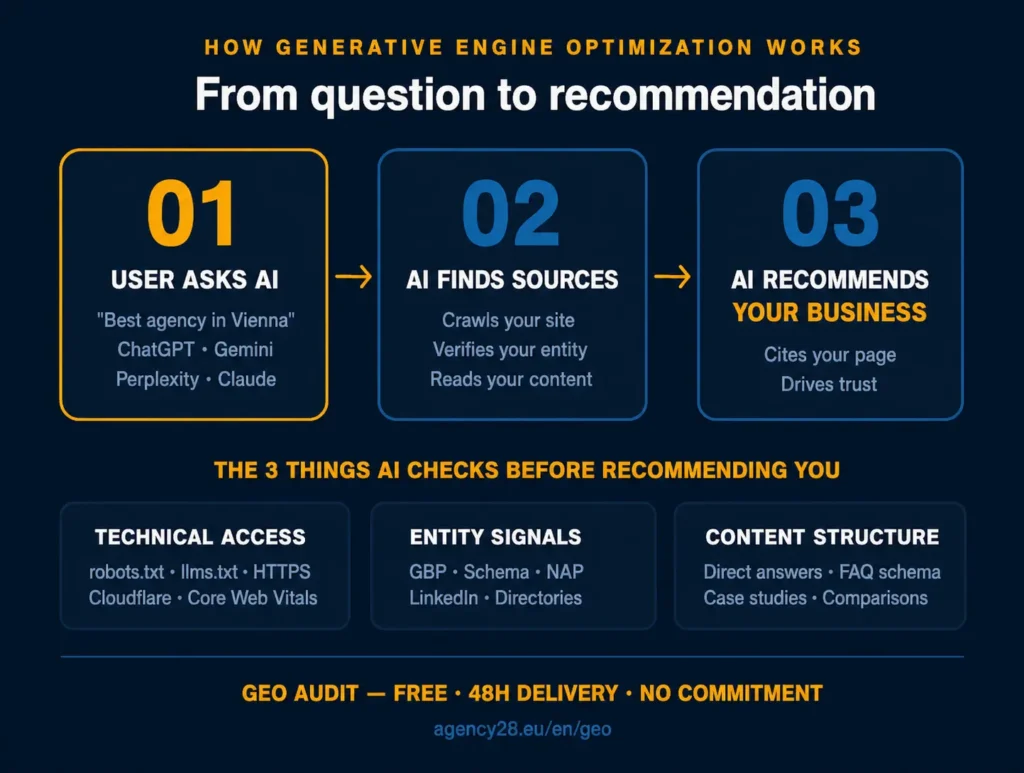
A user types a question into ChatGPT, Gemini, or Perplexity. The AI system retrieves information from across the web, evaluates sources based on credibility, consistency, and clarity, and then constructs an answer. That answer often includes specific brands or providers. The businesses that show up in those answers didn't get there by accident. They got there because they made it easy for the AI to understand them, trust them, and reference them.
That's the entire game.
The three pillars of GEO
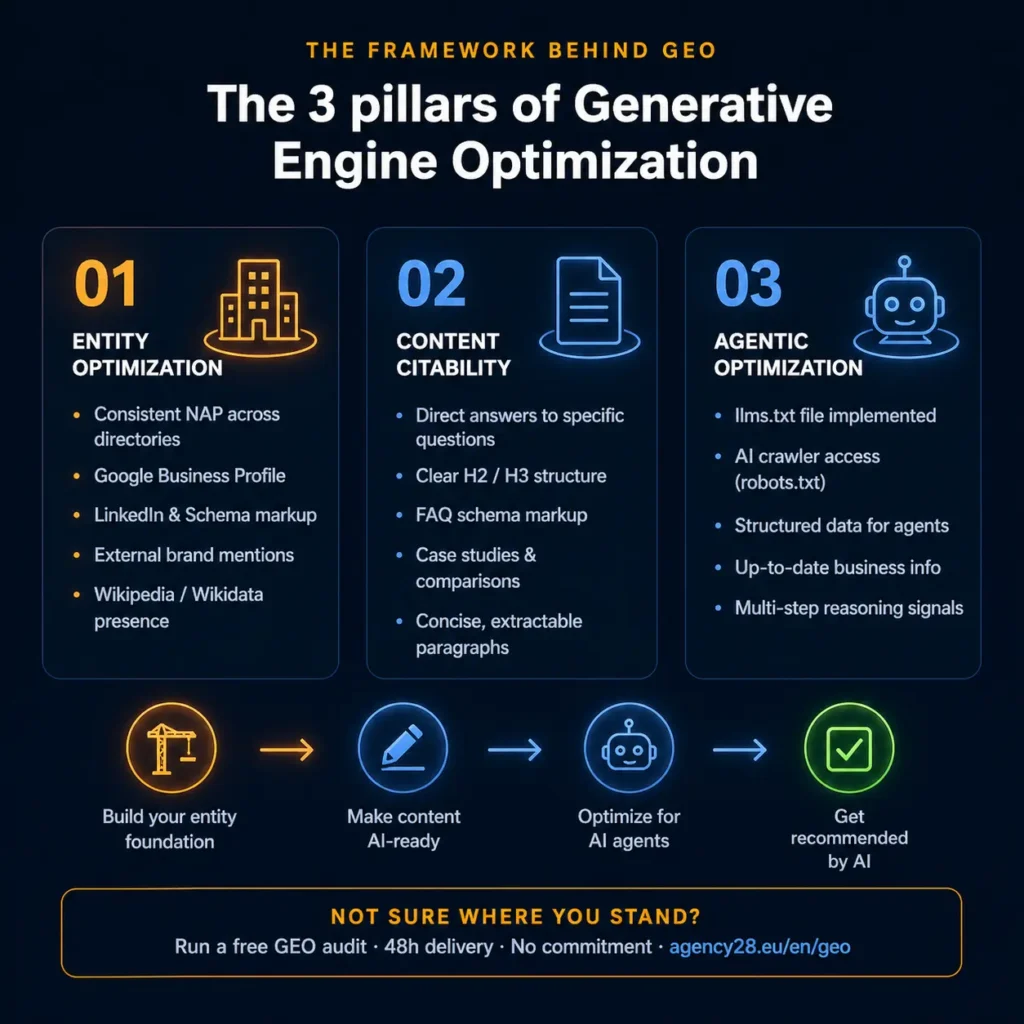
There are three areas where GEO work actually happens.
1. Entity optimization
Entity optimization is about making sure your business exists clearly and consistently across the web. AI systems don't just read your website in isolation. They cross-reference it against LinkedIn, directories, third-party mentions, reviews, and structured data. If these signals are inconsistent or sparse, AI systems won't have enough confidence to recommend you. This is foundational work and it's often where businesses have the biggest gaps.
2. Content citability
Content citability is about making your content usable by AI, not just readable by humans. AI systems extract, synthesize, and reuse content. Content that answers specific questions directly, uses clear structure, and gets to the point is far more likely to be cited than long-form articles that bury the answer in the sixth paragraph. This doesn't mean writing worse content. It means writing content that works on two levels simultaneously.
3. Agentic optimization
Agentic optimization focuses on being selected in scenarios where AI doesn’t just answer questions but compares options and recommends specific solutions. Instead of simply retrieving information, AI systems evaluate which businesses best match a user’s needs. To appear in those recommendations, your company must be clearly positioned, consistently represented across sources, and easy to compare through structured, decision-oriented content. In this context, visibility is no longer about being found — it’s about being chosen.
GEO vs. SEO: do you have to choose?
No, and anyone telling you otherwise is oversimplifying.
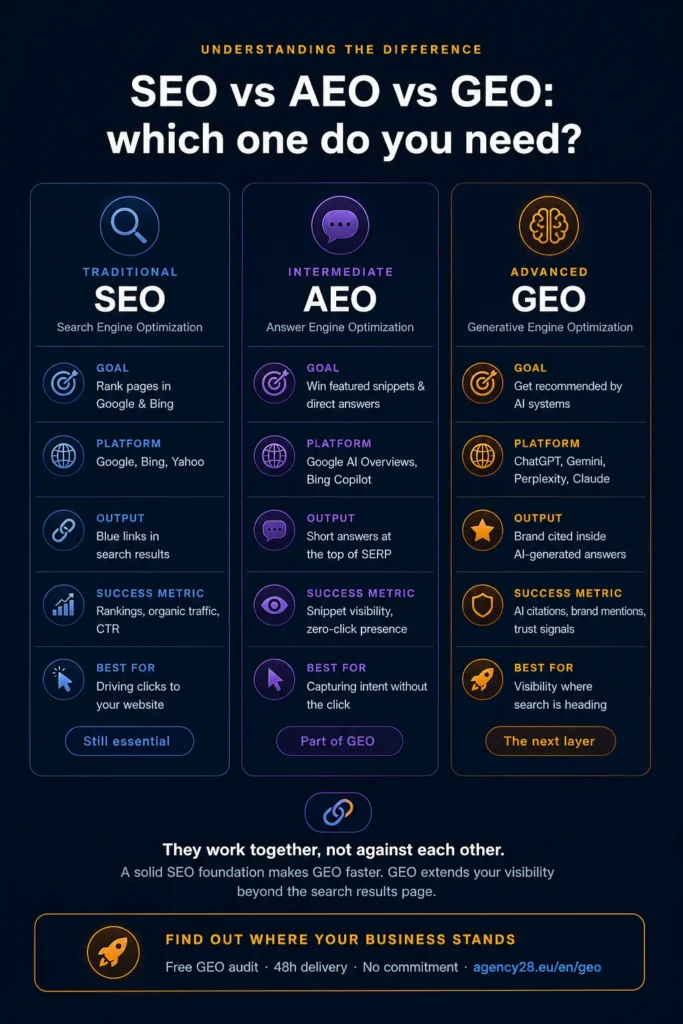
SEO and GEO are solving different problems. SEO gets people to your website by helping you rank in search results. GEO gets you mentioned inside AI-generated answers, where the click may never happen but the brand impression still does. Research analyzed by Ahrefs shows that AI-referred traffic, while much lower in volume, converts significantly better than traditional organic traffic. These are different audiences at different points in the decision-making process, and both matter.
The businesses that will struggle are the ones that spend the next two years doubling down on SEO alone while their competitors quietly build AI visibility.
GEO vs. AEO
These terms are often used interchangeably, but they're not the same. Answer Engine Optimization (AEO) is focused on capturing featured snippets and direct answer boxes in Google. It's a real strategy and it's still valuable. GEO is broader. It's about showing up across AI systems generally, including standalone AI assistants, agentic systems, and AI-powered search interfaces that don't produce traditional rankings at all.
Think of AEO as one tactic within a larger GEO strategy.
Who needs GEO right now
The honest answer is most B2B businesses, SaaS companies, and local service providers. These are the categories where AI is already influencing decisions before a prospect ever visits a website.
IIn B2B specifically, buyers use AI to shortlist vendors, compare categories, and understand unfamiliar solutions. If a prospect asks ChatGPT "what's the best BPM software for mid-size enterprises" and your product isn't mentioned, you've lost a consideration-stage opportunity before the sales cycle even started. That's not a hypothetical. It's happening now — and understanding how AI Decides Which Businesses to Recommend.
How long does GEO take
Technical fixes move fastest. Crawlability issues, robots.txt problems, or AI crawler blocking can usually be resolved within a few weeks and tend to show measurable impact within 30 to 60 days.
Content and entity work takes longer. Most businesses see meaningful changes in AI visibility within 60 to 90 days, but the compounding effect is what makes GEO worth starting early. The businesses building these foundations now will be significantly harder to displace in 12 months.
30–60 days
Technical fixes: crawlability, AI crawler access, structured data, robots.txt.
60–90 days
Content and entity impact: citable content, consistent signals, external mentions.
12 months+
Compounding advantage: harder to displace, stronger AI visibility across platforms.
The earlier the start, the larger the advantage.
GEO in practice: three real scenarios
The easiest way to understand what GEO actually changes is to look at concrete situations where it makes or breaks visibility.
A B2B SaaS company
A process management software company has solid SEO. Good rankings, decent traffic. But when a procurement manager at a mid-size manufacturer asks ChatGPT to recommend tools for mapping their internal workflows, the company doesn't appear anywhere in the answer. Why? Their content describes features well but doesn't explain concepts. There's no clear, citable definition of what business process management is, no structured comparison of approaches, no external mentions from industry publications that would reinforce their authority on the topic.
A competitor with half the domain authority but better-structured, concept-first content gets recommended instead. The prospect never visits either website. They just go with the name the AI gave them.
A local service business
A marketing agency in Vienna has strong Google reviews, a well-maintained Google Business Profile, consistent NAP data across directories, and a few mentions in local business media. When someone asks Perplexity for digital marketing agencies in Vienna that specialize in SEO, the agency comes up. Not because they paid for it. Because their entity signals are coherent enough for the AI to trust them as a real, established business in that category.
A competitor with a flashier website but scattered or inconsistent information across platforms doesn't appear at all. The AI simply doesn't have enough confidence to recommend them.
An eCommerce store
A specialty outdoor equipment store structures its product pages around real use cases: which sleeping bag works best above 3,000 meters, how to choose trekking poles for technical terrain, what layering system makes sense for alpine conditions in spring. When a user asks an AI assistant to help them prepare for a multi-day hiking trip in the Alps, several of that store's product recommendations and comparison guides get pulled into the answer.
The store didn't rank for a keyword. It got cited as a useful, trustworthy source for a specific decision. That's what content citability looks like in practice.
A quick self-assessment
If you want a rough sense of where you stand, ask yourself:
- Can AI crawlers actually access your website, or are they blocked?
- Is your business information consistent across your website, LinkedIn, Google Business Profile, and third-party directories?
- Do external sources mention or link to your business in ways that reinforce your expertise?
- Does your content answer specific questions directly, or does it mostly describe what you do in general terms?
- Can your key pages be summarized by an AI system without losing the core message?
A "no" on most of these is a signal that your business is likely underrepresented in AI-generated answers today.
Where GEO really starts
Most businesses exploring GEO discover the same thing quickly: the problem isn’t AI visibility — it’s the foundation.
Not because they haven’t invested in SEO, but because GEO exposes gaps that traditional SEO often allowed to exist: inconsistent business signals, content that describes instead of explains, and little presence beyond their own website.
Here’s the reality: GEO doesn’t replace SEO. It reveals it.
AI systems rely on the same fundamentals search engines always have — crawlability, structure, authority, and consistency — but apply them in a stricter way. If those signals are weak, you don’t just rank lower.
You don’t get selected at all.
If your SEO foundation is solid, GEO becomes your competitive advantage.
If it isn’t, that’s where the work begins.
Because in AI-driven search, it’s not about ranking anymore.
It’s about being chosen.
FAQ
What is GEO in SEO? +
GEO is the evolution of SEO focused on optimizing for AI systems instead of search engines.
How is GEO different from SEO? +
SEO ranks pages in search results, while GEO helps your business appear inside AI-generated answers. They solve different problems and work best together.
Does GEO replace SEO? +
No. GEO builds on SEO. Without a strong SEO foundation — clean site structure, crawlability, topical authority — GEO won't work effectively. Think of SEO as the floor and GEO as the next layer on top.
Why is my business not showing in AI answers? +
Usually due to weak entity signals, unclear positioning, or content that is not easy for AI to extract and reuse. In most cases, the gaps are fixable — but you need to know where they are first. That's exactly what a GEO audit identifies.
How do I optimize for AI search? +
Focus on three things: clear content that answers specific questions directly, consistent business information across all platforms, and strong external signals that AI systems can trust. Those are the three pillars of GEO.
How long does GEO take to work? +
Initial improvements can appear in 30–90 days, depending on technical, content, and entity factors. Technical fixes tend to move fastest. Content and entity work takes longer but compounds over time.
Who needs GEO the most? +
B2B companies, SaaS products, and local service businesses benefit the most from GEO today. These are the categories where AI is already influencing purchase decisions before a prospect ever visits a website.
Can small businesses compete with GEO? +
Yes. Smaller businesses can actually outperform larger ones if they have clearer positioning and stronger, more consistent signals in a focused topic area. GEO rewards specificity, not size.
Which AI platforms matter for GEO? +
The main platforms right now are ChatGPT, Gemini, Perplexity, and Claude. The list will grow as more products integrate AI-powered search and recommendation systems.
Is GEO just a trend? +
No. GEO reflects a fundamental shift in how users search and how information is delivered online. Gartner predicts a 25% drop in traditional search volume by 2026. This isn't a trend. It's a structural change.