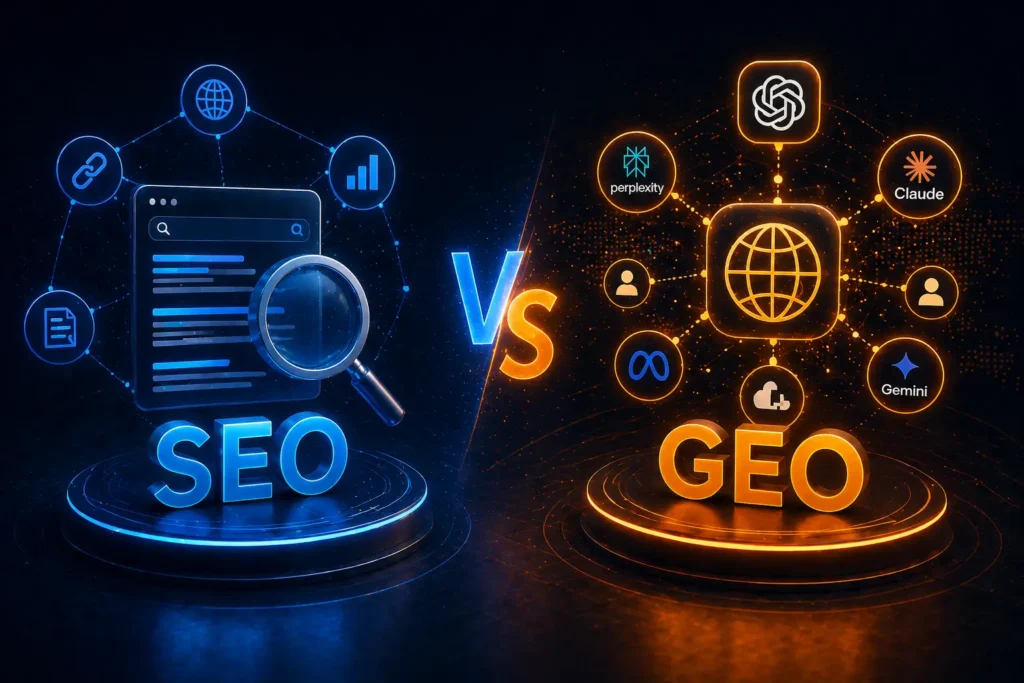
Every week someone asks me whether they should focus on SEO or GEO. It's the wrong question. After years working in search and watching how AI is reshaping discovery, I can tell you that framing it as a choice is the fastest way to end up losing ground on both fronts.
The real question is: do you understand how they differ, and are you optimising for both? If you're not sure what GEO is yet, start here: What Is Generative Engine Optimization (GEO)?
The core difference in one sentence
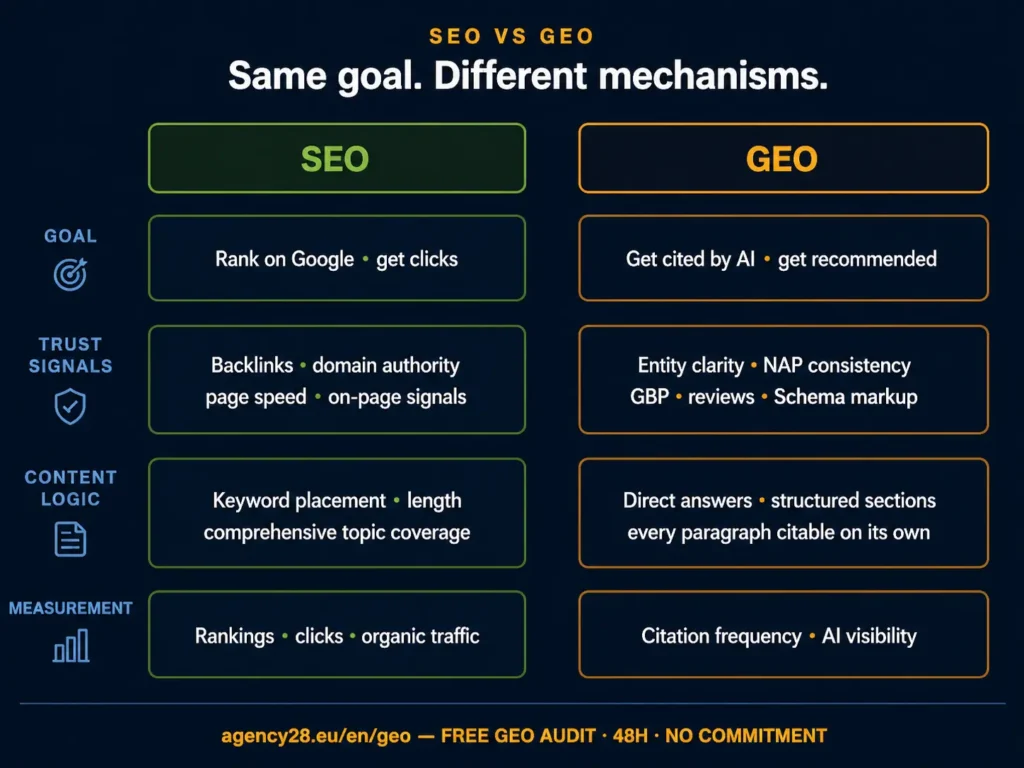
SEO gets you found on Google. GEO gets you recommended by AI. Same goal — visibility — completely different mechanisms.
In SEO, you compete for a position on a results page. The user sees a list of links and chooses which one to click. In GEO, the AI generates a single synthesised answer and cites a handful of sources. Your content is either inside that answer or it isn't. There is no page two in AI search.
What SEO optimises for vs what GEO optimises for
SEO — rankings and clicks
SEO is about earning a ranked position in Google's results. You optimise title tags, headings, and body content for specific keywords. You build backlinks to signal authority. You improve page speed and technical structure so Google can crawl and index your content efficiently.
The payoff is traffic. Someone searches, sees your result, clicks through to your site. The entire chain depends on that click happening.
GEO — citations and recommendations
GEO is about being selected as a source inside an AI-generated answer. You optimise for entity clarity, structured content, and consistent information across platforms. You build trust signals — reviews, third-party citations, verified business profiles — so AI systems can confirm you're a real, credible business.
The payoff is different. Sometimes it's a direct click from a cited source. Often it's brand visibility — the user hears your name or sees your information in the AI's answer before they ever visit your site. AI search visitors convert at 4.4 times the rate of traditional organic visitors, precisely because they arrive having already evaluated options.
Where they overlap — the foundations that serve both
Here's what most people miss: a strong SEO foundation is also a strong GEO foundation. A fast, crawlable, well-structured site helps both. Clear headings, logical content hierarchy, and schema markup benefit both Google and AI systems. High-quality content that answers questions thoroughly performs well in both channels.
This is why I tell clients not to abandon SEO when they start investing in GEO. The businesses winning in AI search in 2026 almost always have solid SEO fundamentals — it's the additional GEO-specific layer that pushes them into AI recommendations.
Where they diverge — the 4 key differences
Keyword logic vs topic clarity
SEO rewards keyword placement — the right terms in your title, headings, and body text. GEO doesn't work that way. AI systems evaluate topics and concepts, not keyword frequency. A page stuffed with "best translation agency Vienna" won't get cited by ChatGPT. A page that clearly explains what you do, for whom, and why you're credible — will.
Backlinks vs entity authority
In SEO, backlinks are the primary trust signal. In GEO, the trust signals are different: consistent NAP data across platforms, a verified Google Business Profile, reviews on relevant directories, LinkedIn presence, and Schema markup. A business with 500 backlinks but no GBP and inconsistent directory listings can rank well on Google and be completely invisible to AI.
Content length vs answer directness
SEO often rewards long, comprehensive content that covers a topic from every angle. GEO rewards directness. AI systems extract fragments — they pull the specific sentence or paragraph that answers a question, regardless of what surrounds it. Every section of your content needs to function as a standalone answer. If the key information is buried after three paragraphs of context, the AI skips it.
Traffic measurement vs citation tracking
SEO success is measured in rankings, clicks, and organic traffic. GEO success is measured differently — how often your brand appears in AI-generated answers, which platforms cite you, and what context surrounds the mention. Most businesses have no visibility into this yet, which is exactly why understanding it now is a competitive advantage.
Can you rank #1 on Google and be invisible to AI?
Yes. And it happens more often than you'd think. A page can rank first for a high-volume keyword and still be completely absent from ChatGPT's answer to the same query. The signals that determine Google rankings and the signals that determine AI citations are related but not identical.
ChatGPT cites webpages ranking in positions 21 or lower nearly 90% of the time. That means a page buried on page two of Google can still be the primary source cited in an AI response — if it has better entity clarity, more direct answers, and stronger trust signals than the pages ranking above it.
This is one of the most important things I've seen in auditing sites for GEO. The playing field isn't what traditional SEO metrics suggest. To understand exactly how AI makes those selection decisions, read this: How AI Decides Which Businesses to Recommend.
The strategy I recommend in 2026
Don't choose between SEO and GEO. Build both in parallel, starting from your existing SEO foundation. Audit your AI visibility to understand where the gaps are, fix the technical and entity issues first — they're usually quick wins — then adapt your content structure so it serves both Google and AI simultaneously.
The businesses that act now have a compounding advantage. AI systems build trust in sources over time, the same way Google builds authority. Starting later means catching up against competitors who are already being cited.
If you want to know exactly where your business stands across both channels, our free GEO audit is the fastest way to find out.
FAQ
What is the main difference between SEO and GEO?
SEO optimises for ranked positions in Google's search results, driving traffic through clicks. GEO optimises for citations inside AI-generated answers from platforms like ChatGPT, Gemini, and Perplexity. SEO success is measured in rankings and traffic. GEO success is measured in how often AI recommends or cites your business.
Does GEO replace SEO?
No. GEO complements SEO — it doesn't replace it. Google still drives enormous amounts of traffic, and strong SEO fundamentals directly support GEO. The businesses winning in 2026 are running both strategies in parallel, not choosing between them.
Can a page rank well on Google but be invisible to AI?
Yes. Google rankings and AI citations are determined by related but different signals. A page can rank first on Google and never appear in ChatGPT's answer to the same query. The reverse is also true — pages ranking on page two of Google are cited in AI responses nearly 90% of the time if they have stronger entity clarity and more direct content structure.
Where should I start if I want to optimise for both SEO and GEO?
Start with a GEO audit. It identifies the specific gaps in your AI visibility — technical access issues, entity signal problems, content structure weaknesses — and tells you what to fix in priority order. Most of the fixes also improve your SEO performance, so the investment serves both channels simultaneously.