Most businesses don’t know if they are visible to AI systems — until they realize they’re not being recommended.
This checklist helps you evaluate your AI visibility in under 5 minutes and identify exactly where the gaps are.
How to use this checklist
Go through each item and mark:
✅ Yes
❌ No
At the end of each section, calculate your score.
This will show you whether your business is:
Visible
Partially visible
Invisible to AI systems
Technical GEO Checklist
☐ Is your website accessible to AI crawlers?
☐ Is your robots.txt not blocking AI bots?
☐ Is your website fast and mobile-friendly?
☐ Is your HTML structure clean (proper H1, H2, etc.)?
☐ Do your pages load without errors or broken elements?
☐ Do you use structured data where relevant?
Score:
0–2 → Weak 3–4 → Needs improvement 5–6 → Strong
Entity GEO Checklist
☐ Is your business information consistent across platforms?
☐ Do you have an active LinkedIn company page?
☐ Are you listed in relevant directories?
☐ Do external websites mention your brand?
☐ Do you have reviews or third-party validation?
☐ Is your positioning clear (what you do, for whom)?
Score:
0–2 → Weak 3–4 → Needs improvement 5–6 → Strong
Content GEO Checklist
☐ Does your content answer specific questions clearly?
☐ Are key concepts explained (not just described)?
☐ Do you use structured formatting (lists, sections)?
☐ Can your content be easily summarized?
☐ Do you cover topics in depth (not just surface-level)?
☐ Do you create comparison or decision content?
Score:
0–2 → Weak 3–4 → Needs improvement 5–6 → Strong
(Optional) Agentic GEO Checklist
☐ Is your offering clearly positioned for a specific audience?
☐ Do you have comparison pages (vs competitors)?
☐ Can AI easily understand when to recommend you?
☐ Is your pricing / value proposition clear?
☐ Do you appear in decision-oriented content?
Score:
0–2 → Weak 3–4 → Needs improvement 5 → Strong
Your GEO Score
Mostly “Weak” → Your business is likely invisible to AI
Mixed → Partial visibility, but unreliable
Mostly “Strong” → You are in a position to be recommended
What to do next
Most businesses don’t fail because they ignore GEO. They fail because they assume their SEO foundation is enough.
If your score is low, the next step is identifying:
technical gaps
missing entity signals
content weaknesses
Because in AI-driven search, visibility doesn’t come from ranking.
It comes from being selected.
GOOGLE SHEETS VERSION (LISTA PARA COPIAR)
Category,Question,Answer (Yes/No),Notes
Technical,Is your website accessible to AI crawlers?,,
Technical,Is your robots.txt not blocking AI bots?,,
Technical,Is your website fast and mobile-friendly?,,
Technical,Is your HTML structure clean?,,
Technical,Do pages load without errors?,,
Technical,Do you use structured data?,,
Entity,Is your business info consistent across platforms?,,
Entity,Do you have an active LinkedIn page?,,
Entity,Are you listed in directories?,,
Entity,Do external sites mention your brand?,,
Entity,Do you have reviews or validation?,,
Entity,Is your positioning clear?,,
Content,Does your content answer specific questions clearly?,,
Content,Are key concepts explained?,,
Content,Do you use structured formatting?,,
Content,Can your content be easily summarized?,,
Content,Do you cover topics in depth?,,
Content,Do you create comparison content?,,
Agentic,Is your offering clearly positioned?,,
Agentic,Do you have comparison pages?,,
Agentic,Can AI understand when to recommend you?,,
Agentic,Is pricing/value clear?,,
Agentic,Do you appear in decision content?,,
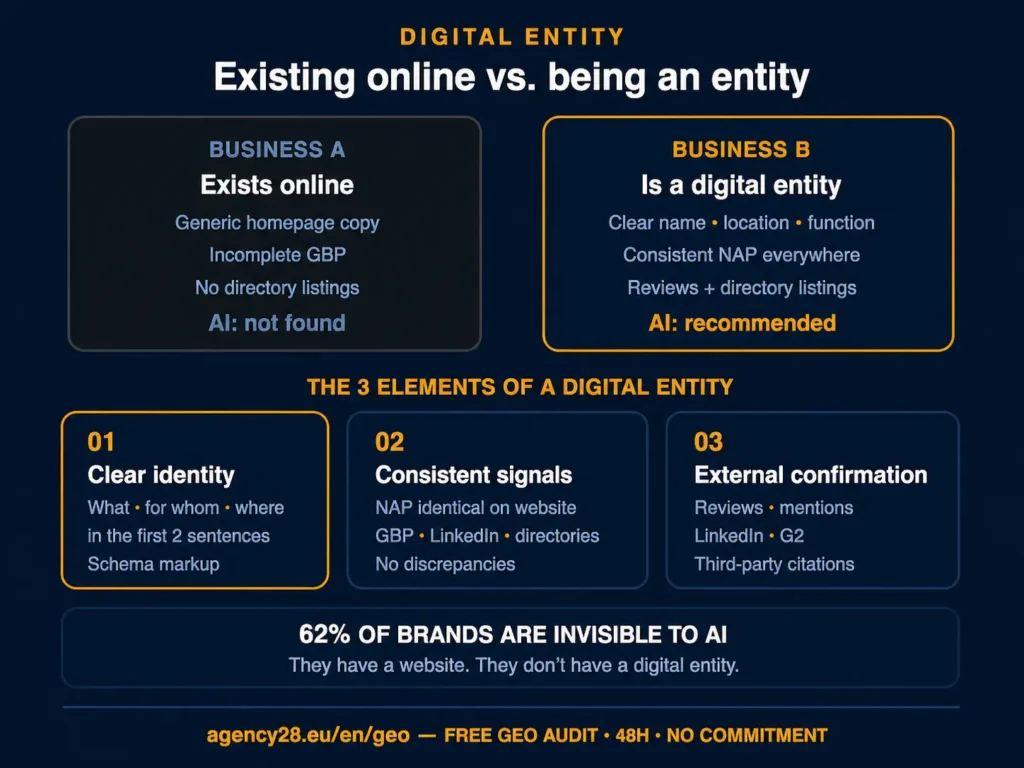
When I explain why a business is invisible in AI search, I almost always come back to the same point: the business exists online — but it isn’t a digital entity. That’s the difference that explains everything. And it’s the concept that most articles about GEO either skip or explain badly.
Google and traditional search engines think in keywords. You enter a term, the machine looks for pages containing that term, and ranks them by relevance and authority. AI systems think differently. They think in entities.
An entity, for an AI system, is a clearly identifiable thing in the world — a business, a person, a place, a product. AI builds an internal knowledge graph: which entities exist, what their properties are, what relationships they have with other entities. When someone asks a question, the AI doesn’t search for pages with the right keywords — it searches for entities that can answer the question.
If your business isn’t registered as an entity in that knowledge graph, you simply don’t exist for the AI. Not poorly visible. Not hard to find. Non-existent. To understand how AI uses this process to make recommendations, read this: How AI Decides Which Businesses to Recommend.
What makes a business a digital entity
A digital entity isn’t a technical status you apply for. It’s a state you reach through consistent, verifiable online presence. Three elements are required.
A clear name, location and function
The AI needs to clearly identify: what is this business called? Where does it operate? What does it do? These three pieces of information need to be available on your homepage in the first two sentences — not somewhere on an about page, not in the footer, not after a long introduction. Immediately, clearly, specifically.
Bad example: “We provide innovative digital solutions for forward-thinking businesses.”
Good example: “Agency28 is a GEO and SEO agency in Vienna that helps SMBs in the DACH market become visible in AI search.”
The difference isn’t aesthetic. It’s functional. The second version can be classified by an AI system. The first one can’t.
Consistent signals across the web
An entity doesn’t only exist on one page — it exists across the web as a whole. That means your business name, address, and phone number need to be identical on your website, Google Business Profile, LinkedIn, industry directories, and review platforms. Every discrepancy weakens the entity signal. The AI starts to question whether it’s dealing with one entity or several.
External confirmation from third parties
The strongest entity signal doesn’t come from you — it comes from others. When independent sources mention, link to, or review your business, they confirm to AI systems: this entity is real and relevant. That can be reviews, mentions in articles, directory listings, or citations on platforms like LinkedIn or G2. I explain how these external signals work in detail here: The 3 Trust Signals AI Uses to Decide Whether to Recommend Your Business.
[wpcode id=”363″]
Why most businesses don’t qualify as entities yet
94% of brands invest in traditional SEO. But 62% are invisible to generative AI models — when asked directly about services in their category, they’re not cited in 81% of cases. The reason is almost always the same: they have a website, but not a coherent digital entity.
This happens for three reasons. First: the homepage describes the business too vaguely to be classified. Second: the information is inconsistent across platforms. Third: there are no or too few external sources confirming the business exists.
None of these problems are technically complex. All three are fixable — and faster than most people think.
The difference between existing online and being an entity
Imagine two businesses, both with a website, both with a Google Business Profile, both operating in the same market.
Business A has a homepage with generic marketing copy, a GBP with missing service details, and doesn’t appear in any relevant directory. It exists online.
Business B has a homepage that explains in two sentences what it does, for whom, and where. Its GBP is fully completed and consistent with the website. It has reviews on three relevant platforms and is listed in the main industry directories. It is a digital entity.
When someone asks ChatGPT “which translation agency in Vienna is good for medical documents?”, Business B appears. Business A doesn’t — even though it might offer the better service.
How to build your digital entity step by step
Building a digital entity follows a clear sequence. First the foundation: rewrite the homepage text so that name, location, and function are immediately recognisable. Implement Schema markup of the LocalBusiness or ProfessionalService type. Then consistency: align NAP data across all platforms — website, GBP, LinkedIn, directories. Then external validation: actively collect reviews, list in relevant directories, build LinkedIn presence.
Most businesses can complete the first two steps within two to four weeks. External validation takes longer — but the effect is cumulative and grows over time.
If you want to know where you currently stand and which of these elements you’re missing, a GEO audit is the fastest way to find out.
[wpcode id=”363″]
FAQ
What is a digital entity?
A digital entity is a clearly identifiable thing on the web — in this context, a business that AI systems can unambiguously classify. That requires a clear name, location, and function on your own website, consistent information across all relevant platforms, and external confirmation through reviews, directory listings, and third-party mentions.
What’s the difference between having a website and being a digital entity?
Having a website means being present online. Being a digital entity means AI systems can clearly identify, classify, and categorise your business as trustworthy. That requires more than a website — it requires consistent, verifiable signals from multiple independent sources.
Do I need a Wikipedia entry to be a digital entity?
No. Wikipedia is a strong entity signal but not a necessary one. For most SMBs, a complete Google Business Profile, consistent NAP data, Schema markup, and reviews on relevant platforms is sufficient to be classified as an entity. Wikipedia becomes relevant when you’re operating in a very competitive market.
How long does it take to build a digital entity?
The technical and content foundations — homepage text, Schema markup, NAP consistency — can be implemented within two to four weeks. External validation through reviews and third-party mentions typically takes two to three months for measurable results. The overall process is iterative: each improvement gradually strengthens the entity signal.
Wenn ich erkläre, warum ein Unternehmen in KI-Suchen unsichtbar ist, komme ich fast immer zum selben Punkt: Das Unternehmen existiert online — aber es ist keine digitale Entität. Das ist der Unterschied, der alles erklärt. Und es ist das Konzept, das die meisten Artikel über GEO entweder überspringen oder schlecht erklären.
Google und traditionelle Suchmaschinen denken in Keywords. Du gibst einen Begriff ein, die Maschine sucht nach Seiten, die diesen Begriff enthalten, und rankt sie nach Relevanz und Autorität. KI-Systeme denken anders. Sie denken in Entitäten.
Eine Entität ist für ein KI-System ein klar identifizierbares Ding in der Welt — ein Unternehmen, eine Person, ein Ort, ein Produkt. KI baut intern eine Art Wissensgraph auf: Welche Entitäten existieren? Was sind ihre Eigenschaften? Welche Beziehungen haben sie zu anderen Entitäten? Wenn jemand eine Frage stellt, sucht die KI nicht nach Seiten mit den richtigen Keywords — sie sucht nach Entitäten, die die Frage beantworten können.
Wenn dein Unternehmen in diesem Wissensgraph nicht als Entität registriert ist, bist du für die KI schlicht nicht vorhanden. Nicht schlecht sichtbar. Nicht schwer zu finden. Nicht vorhanden. Um zu verstehen, wie KI diesen Prozess nutzt, um Empfehlungen zu treffen, lies das hier: Wie KI entscheidet, welche Unternehmen sie empfiehlt.
Was ein Unternehmen zu einer digitalen Entität macht
Eine digitale Entität ist kein technischer Status, den du beantragst. Es ist ein Zustand, den du durch konsistente, verifizierbare Online-Präsenz erreichst. Drei Elemente sind notwendig.
Ein klarer Name, Standort und Funktion
Die KI muss eindeutig identifizieren können: Wie heißt dieses Unternehmen? Wo ist es tätig? Was macht es? Diese drei Informationen müssen auf deiner Homepage in den ersten zwei Sätzen verfügbar sein — nicht irgendwo auf einer Über-uns-Seite, nicht im Footer, nicht in einer langen Einleitung. Sofort, klar, spezifisch.
Schlechtes Beispiel: “Wir bieten innovative digitale Lösungen für zukunftsorientierte Unternehmen.” Gutes Beispiel: “Agency28 ist eine GEO- und SEO-Agentur in Wien, die KMUs im DACH-Markt dabei hilft, in KI-Suchen sichtbar zu werden.”
Der Unterschied ist nicht ästhetisch. Er ist funktional. Die zweite Version kann von einem KI-System klassifiziert werden. Die erste kann es nicht.
Konsistente Signale im gesamten Web
Eine Entität existiert nicht nur auf einer Seite — sie existiert im Web als Ganzes. Das bedeutet: Dein Unternehmensname, deine Adresse und deine Telefonnummer müssen auf deiner Website, deinem Google Business Profile, LinkedIn, Branchenverzeichnissen und Bewertungsplattformen identisch sein. Jede Abweichung schwächt das Entitätssignal. Die KI beginnt zu zweifeln, ob sie mit einer oder mehreren Entitäten zu tun hat.
Externe Bestätigung durch Dritte
Das stärkste Entitätssignal kommt nicht von dir selbst — es kommt von anderen. Wenn unabhängige Quellen dein Unternehmen erwähnen, verlinken oder bewerten, bestätigen sie gegenüber KI-Systemen: Diese Entität ist real und relevant. Das können Bewertungen sein, Erwähnungen in Artikeln, Einträge in Verzeichnissen oder Zitierungen auf Plattformen wie LinkedIn oder G2. Wie diese externen Signale funktionieren, erkläre ich detailliert hier: Die 3 Vertrauenssignale, mit denen KI entscheidet, ob sie dein Unternehmen empfiehlt.
[wpcode id=”362″]
Warum die meisten Unternehmen noch keine Entität sind
94% der Marken investieren in traditionelles SEO. Aber 62% sind für generative KI-Modelle unsichtbar — wenn man sie direkt nach Dienstleistungen in ihrer Kategorie fragt, werden sie in 81% der Fälle nicht zitiert. Der Grund ist fast immer derselbe: Sie haben eine Website, aber keine kohärente digitale Entität.
Das passiert aus drei Gründen. Erstens: Die Homepage beschreibt das Unternehmen zu vage, um klassifiziert zu werden. Zweitens: Die Informationen sind auf verschiedenen Plattformen inkonsistent. Drittens: Es gibt keine oder zu wenige externe Quellen, die die Existenz des Unternehmens bestätigen.
Keines dieser Probleme ist technisch komplex. Alle drei sind behebbar — und schneller als die meisten denken.
Der Unterschied zwischen online existieren und eine Entität sein
Stell dir zwei Unternehmen vor, beide mit einer Website, beide mit einem Google Business Profile, beide im selben Markt tätig.
Unternehmen A hat eine Homepage mit generischem Marketingtext, ein GBP mit fehlenden Servicedetails, und taucht in keinem relevanten Verzeichnis auf. Es existiert online.
Unternehmen B hat eine Homepage, die in zwei Sätzen erklärt, was es macht, für wen und wo. Sein GBP ist vollständig ausgefüllt und mit der Website konsistent. Es hat Bewertungen auf drei relevanten Plattformen und ist in den wichtigsten Branchenverzeichnissen gelistet. Es ist eine digitale Entität.
Wenn jemand ChatGPT fragt “Welche Übersetzungsagentur in Wien ist gut für medizinische Dokumente?”, erscheint Unternehmen B. Unternehmen A erscheint nicht — obwohl es vielleicht die bessere Dienstleistung anbietet.
Wie du deine digitale Entität Schritt für Schritt aufbaust
Der Aufbau einer digitalen Entität folgt einer klaren Reihenfolge. Zuerst die Grundlage: Homepage-Text überarbeiten, damit Name, Standort und Funktion sofort erkennbar sind. Schema-Markup vom Typ LocalBusiness oder ProfessionalService implementieren. Dann die Konsistenz: NAP-Daten auf allen Plattformen angleichen — Website, GBP, LinkedIn, Verzeichnisse. Dann die externe Validierung: Aktiv Bewertungen sammeln, in relevante Verzeichnisse eintragen, Präsenz auf LinkedIn aufbauen.
Die meisten Unternehmen können die ersten beiden Schritte innerhalb von zwei bis vier Wochen abschließen. Die externe Validierung braucht länger — aber der Effekt ist kumulativ und wächst mit der Zeit.
Wenn du wissen willst, wo du gerade stehst und welche dieser Elemente bei dir fehlen, ist ein GEO-Audit der schnellste Weg, das herauszufinden.
[wpcode id=”362″]
FAQ
Was ist eine digitale Entität?
Eine digitale Entität ist ein klar identifizierbares Ding im Web — in diesem Kontext ein Unternehmen, das KI-Systeme eindeutig klassifizieren können. Das erfordert einen klaren Namen, Standort und Funktion auf der eigenen Website, konsistente Informationen auf allen relevanten Plattformen, und externe Bestätigung durch Bewertungen, Verzeichniseinträge und Drittanbieter-Erwähnungen.
Was ist der Unterschied zwischen einer Website haben und eine digitale Entität sein?
Eine Website zu haben bedeutet, online präsent zu sein. Eine digitale Entität zu sein bedeutet, dass KI-Systeme dein Unternehmen eindeutig identifizieren, klassifizieren und als vertrauenswürdig einordnen können. Das erfordert mehr als eine Website — es erfordert konsistente, verifizierbare Signale aus mehreren unabhängigen Quellen.
Brauche ich einen Wikipedia-Eintrag, um eine digitale Entität zu sein?
Nein. Wikipedia ist ein starkes Entitätssignal, aber kein notwendiges. Für die meisten KMUs ist ein vollständiges Google Business Profile, konsistente NAP-Daten, Schema-Markup und Bewertungen auf relevanten Plattformen ausreichend, um als Entität klassifiziert zu werden. Wikipedia wird erst relevant, wenn du in einem sehr wettbewerbsintensiven Markt operierst.
Wie lange dauert es, eine digitale Entität aufzubauen?
Die technischen und inhaltlichen Grundlagen — Homepage-Text, Schema-Markup, NAP-Konsistenz — können innerhalb von zwei bis vier Wochen umgesetzt werden. Die externe Validierung durch Bewertungen und Drittanbieter-Erwähnungen braucht typischerweise zwei bis drei Monate für messbare Ergebnisse. Der Gesamtprozess ist iterativ: Jede Verbesserung stärkt das Entitätssignal schrittweise.
When I talk to local business owners, the most common assumption is that GEO is something for big brands with big budgets. The opposite is true. From everything I’ve seen in audits, local SMBs start with a structural advantage over national and international competitors in GEO — and almost nobody is using it.
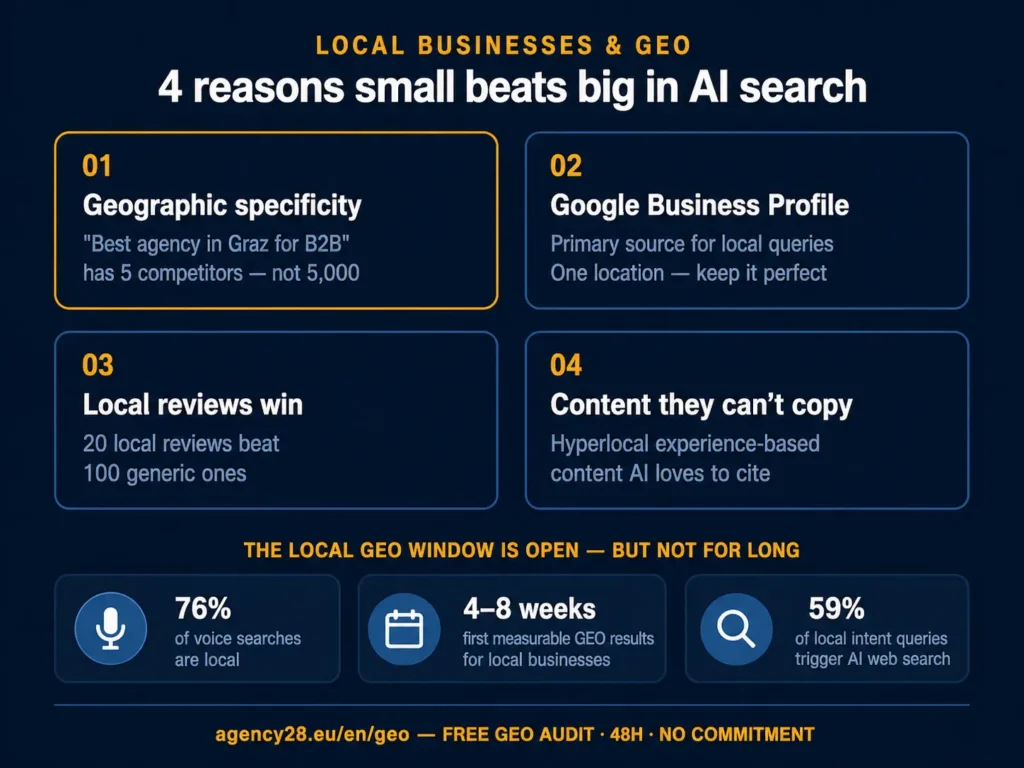
76% of all voice searches are local. And local queries are exactly the type of query that AI systems most often answer with a direct recommendation — not a list of links, but a name, an address, a concrete suggestion.
“Which accountant in Vienna is good for freelancers?” “Best translation agency in Munich for technical documents?” These aren’t abstract information requests. These are purchase decisions. And AI is answering them every day — with or without you.
The key difference from general queries: local queries have fewer competitors. “Best marketing agency” has thousands of pages competing for citations. “Best marketing agency in Graz for B2B companies” might have five — and most of them are poorly optimised for GEO.
[wpcode id=”363″]
The local advantage — 4 reasons small beats big in AI search
Geographic specificity is easier to own
Big brands fight for national and international visibility. You fight for Vienna, for the 9th district, for “medical document translators in Austria”. That’s a much smaller battlefield — and a much easier one to win. AI systems prefer specific, clearly located answers over generic ones. The more precise your geographic positioning, the easier you are to recommend.
Google Business Profile carries more weight locally
For local queries, Google Business Profile is one of the primary sources AI systems consult. A complete, verified GBP with current opening hours, correct address, and detailed service descriptions gives AI exactly the structured data it needs. Large brands often have inconsistent or incomplete GBP entries across multiple locations. You have one — and you can keep it perfect.
Local reviews are more trusted by AI
For local recommendations, AI systems weight reviews from real local customers particularly highly. A trade business with 40 Google reviews from the local area beats a national chain with 200 generic reviews — because the local reviews combine geographic relevance with real customer interaction. That’s an advantage you build organically as a local business.
You can create content national competitors can’t match
A national competitor can’t create a page that authentically talks about “the most common accounting mistakes at Vienna restaurant businesses”. You can — because you live it. This kind of hyperlocal, experience-based content is exactly what AI systems cite: specific, credible, non-reproducible.
The local signals AI uses to recommend businesses near you
AI systems combine several local data points before recommending a business for a geographic query. The most important are: Google Business Profile with complete data and active reviews, NAP consistency across all local directories, LocalBusiness Schema markup on the website, and local content that answers specific questions from the target market.
They wait. They assume GEO is something for later — when the technology is more mature, when more customers use AI, when competitors start doing it too. That’s the most expensive mistake they can make.
AI systems build trust in sources over time. A business that today has a complete GBP, consistent NAP data, and local content with direct answers will be systematically preferred in six months over a competitor who starts then. The compounding effect works exactly like SEO — whoever starts earlier has a structural advantage that’s hard to close.
According to HubSpot data, local businesses can see first measurable GEO results within 4 to 8 weeks — faster than most other business types. The entry point is low. The barrier is knowledge, not budget.
How to claim your local GEO advantage today
The first step is understanding where you currently stand. Which of your local queries is AI already answering? Who’s being recommended — you or a competitor? Which of your GEO signals are missing or inconsistent?
Our free GEO audit answers exactly these questions — for your specific business, your market, and your geographic positioning. Within 48 hours you’ll know where you stand and what to do next.
[wpcode id=”363″]
FAQ
Do local businesses really have an advantage over big brands in GEO?
Yes, structurally. Local businesses can dominate geographic niches that are too specific for national competitors. AI systems prefer precise, located answers for local queries — and a well-optimised local business regularly beats a large brand with poor local signals.
How important is Google Business Profile for local GEO?
Very important. For local queries, GBP is one of the primary sources AI systems consult. It needs to be fully completed, verified, and consistent with the information on your website. Service descriptions, opening hours, and reviews are particularly relevant.
How many reviews do I need for AI to recommend me locally?
Five reviews per platform is the minimum threshold at which external validation becomes measurable. For local GEO visibility, the quality and geographic relevance of reviews matters more than the raw number. 20 genuine local reviews beat 100 generic ones.
Can a small local business win at GEO without a big budget?
Yes. Most GEO fundamentals — NAP consistency, GBP optimisation, Schema markup, local FAQ pages — require time, not a big budget. Local businesses that implement these foundations correctly typically see first results within 4 to 8 weeks.
Wenn ich mit lokalen Unternehmern spreche, ist die häufigste Annahme: GEO ist etwas für große Marken mit großen Budgets. Das Gegenteil ist wahr. Nach allem, was ich in Audits gesehen habe, starten lokale KMUs bei GEO mit einem strukturellen Vorteil gegenüber nationalen und internationalen Wettbewerbern — und fast keiner nutzt ihn.
76% aller Sprachsuchen sind lokal. Und lokale Suchanfragen sind genau die Art von Anfragen, die KI-Systeme am häufigsten mit einer direkten Empfehlung beantworten — nicht mit einer Liste von Links, sondern mit einem Namen, einer Adresse, einem konkreten Vorschlag.
“Welcher Steuerberater in Wien ist empfehlenswert für Selbstständige?” “Beste Übersetzungsagentur in München für technische Dokumente?” Das sind keine abstrakten Informationsanfragen. Das sind Kaufentscheidungen. Und KI beantwortet sie täglich — mit oder ohne dich.
Der entscheidende Unterschied zu allgemeinen Suchanfragen: Bei lokalen Anfragen gibt es weniger Wettbewerber. “Beste Marketingagentur” hat tausende von Seiten, die um Zitierungen kämpfen. “Beste Marketingagentur in Graz für B2B-Unternehmen” hat vielleicht fünf — und die meisten davon sind schlecht für GEO optimiert.
[wpcode id=”362″]
Der lokale Vorteil — 4 Gründe, warum Klein Groß schlägt in der KI-Suche
Geografische Spezifität ist leichter zu dominieren
Große Marken kämpfen um nationale und internationale Sichtbarkeit. Du kämpfst um Wien, um den 9. Bezirk, um “Übersetzer für medizinische Dokumente in Österreich”. Das ist ein viel kleineres Schlachtfeld — und ein viel leichter zu gewinnendes. KI-Systeme bevorzugen spezifische, klar verortete Antworten gegenüber generischen. Je präziser deine geografische Positionierung, desto leichter bist du zu empfehlen.
Google Business Profile hat lokal mehr Gewicht
Für lokale Anfragen ist Google Business Profile eine der primären Quellen, die KI-Systeme konsultieren. Ein vollständiges, verifiziertes GBP mit aktuellen Öffnungszeiten, korrekter Adresse und detaillierten Servicebeschreibungen gibt KI genau die strukturierten Daten, die sie braucht. Große Marken haben oft inkonsistente oder unvollständige GBP-Einträge über mehrere Standorte hinweg. Du hast einen — und kannst ihn perfekt pflegen.
Lokale Bewertungen werden von KI stärker gewichtet
Bei lokalen Empfehlungen gewichten KI-Systeme Bewertungen von echten lokalen Kunden besonders hoch. Eine Handwerksfirma mit 40 Google-Bewertungen aus dem Bezirk schlägt eine nationale Kette mit 200 generischen Bewertungen — weil die lokalen Bewertungen geografische Relevanz und echte Kundeninteraktion kombinieren. Das ist ein Vorteil, den du als lokales Unternehmen organisch aufbaust.
Du kannst Inhalte erstellen, die nationale Wettbewerber nicht kopieren können
Ein nationaler Wettbewerber kann keine Seite erstellen, die authentisch über “die häufigsten Buchhaltungsfehler bei Wiener Gastronomie-Betrieben” spricht. Du kannst das — weil du es lebst. Diese Art von hyperlokalem, erfahrungsbasiertem Inhalt ist genau das, was KI-Systeme zitieren: spezifisch, vertrauenswürdig, nicht reproduzierbar.
Die lokalen Signale, die KI nutzt, um Unternehmen in deiner Nähe zu empfehlen
KI-Systeme kombinieren mehrere lokale Datenpunkte, bevor sie ein Unternehmen für eine geografische Anfrage empfehlen. Die wichtigsten sind: Google Business Profile mit vollständigen Daten und aktiven Bewertungen, NAP-Konsistenz über alle lokalen Verzeichnisse hinweg, LocalBusiness Schema-Markup auf der Website, und lokale Inhalte die spezifische Fragen des Zielmarkts beantworten.
Sie warten. Sie gehen davon aus, dass GEO etwas für später ist — wenn die Technologie “ausgereifter” ist, wenn mehr Kunden KI nutzen, wenn die Konkurrenz es auch macht. Das ist der teuerste Fehler, den sie machen können.
KI-Systeme bauen Vertrauen in Quellen über Zeit auf. Ein Unternehmen, das heute ein vollständiges GBP, konsistente NAP-Daten und lokale Inhalte mit direkten Antworten hat, wird in sechs Monaten systematisch bevorzugt gegenüber einem Wettbewerber, der dann erst anfängt. Der Compounding-Effekt funktioniert genauso wie bei SEO — wer früher anfängt, hat einen strukturellen Vorteil, der schwer aufzuholen ist.
Laut HubSpot-Daten können lokale Unternehmen erste messbare GEO-Ergebnisse innerhalb von 4 bis 8 Wochen sehen — schneller als die meisten anderen Unternehmenstypen. Der Einstiegspunkt ist niedrig. Die Barriere ist Wissen, nicht Budget.
Wie du deinen lokalen GEO-Vorteil heute nutzt
Der erste Schritt ist zu verstehen, wo du gerade stehst. Welche deiner lokalen Anfragen werden bereits von KI beantwortet? Wer wird empfohlen — du oder ein Wettbewerber? Welche deiner GEO-Signale fehlen oder sind inkonsistent?
Unser kostenloser GEO-Audit beantwortet genau diese Fragen — für dein spezifisches Unternehmen, deinen Markt und deine geografische Positionierung. Innerhalb von 48 Stunden weißt du, wo du stehst und was du als nächstes tun musst.
[wpcode id=”362″]
FAQ
Haben lokale Unternehmen wirklich einen Vorteil bei GEO gegenüber großen Marken?
Ja, strukturell. Lokale Unternehmen können geografische Nischen dominieren, die für nationale Wettbewerber zu spezifisch sind. KI-Systeme bevorzugen präzise, verortete Antworten bei lokalen Anfragen — und ein gut optimiertes lokales Unternehmen schlägt eine große Marke mit schlechten lokalen Signalen regelmäßig.
Wie wichtig ist Google Business Profile für lokales GEO?
Sehr wichtig. Für lokale Anfragen ist GBP eine der primären Quellen, die KI-Systeme konsultieren. Es muss vollständig ausgefüllt, verifiziert und konsistent mit den Informationen auf der Website sein. Servicebeschreibungen, Öffnungszeiten und Bewertungen sind besonders relevant.
Wie viele Bewertungen brauche ich, damit KI mich lokal empfiehlt?
Fünf Bewertungen pro Plattform sind der Mindestschwellenwert, ab dem externe Validierung messbar wird. Für lokale GEO-Sichtbarkeit ist die Qualität und geografische Relevanz der Bewertungen wichtiger als die reine Anzahl. 20 echte lokale Bewertungen schlagen 100 generische.
Kann ein kleines lokales Unternehmen ohne großes Budget in GEO gewinnen?
Ja. Die meisten GEO-Grundlagenmaßnahmen — NAP-Konsistenz, GBP-Optimierung, Schema-Markup, lokale FAQ-Seiten — erfordern Zeit, kein großes Budget. Lokale Unternehmen, die diese Grundlagen richtig umsetzen, sehen typischerweise erste Ergebnisse innerhalb von 4 bis 8 Wochen.
When I audit businesses, the most common problem isn’t that their website is bad. It’s that AI systems simply don’t trust them. And without trust, there’s no recommendation — no matter how good your product or service is.
AI doesn’t recommend businesses it can’t verify. That’s the core mechanism most businesses don’t understand when they wonder why they don’t show up in ChatGPT or Gemini. If you’re not sure what GEO is yet, start here: What Is Generative Engine Optimization (GEO)?
Why AI needs to trust you before it recommends you
AI systems aren’t search engines. They generate answers that they hand directly to users — without the user being able to verify whether the source is trustworthy. That makes AI systems inherently conservative: they only recommend businesses they can classify as real and credible with high confidence.
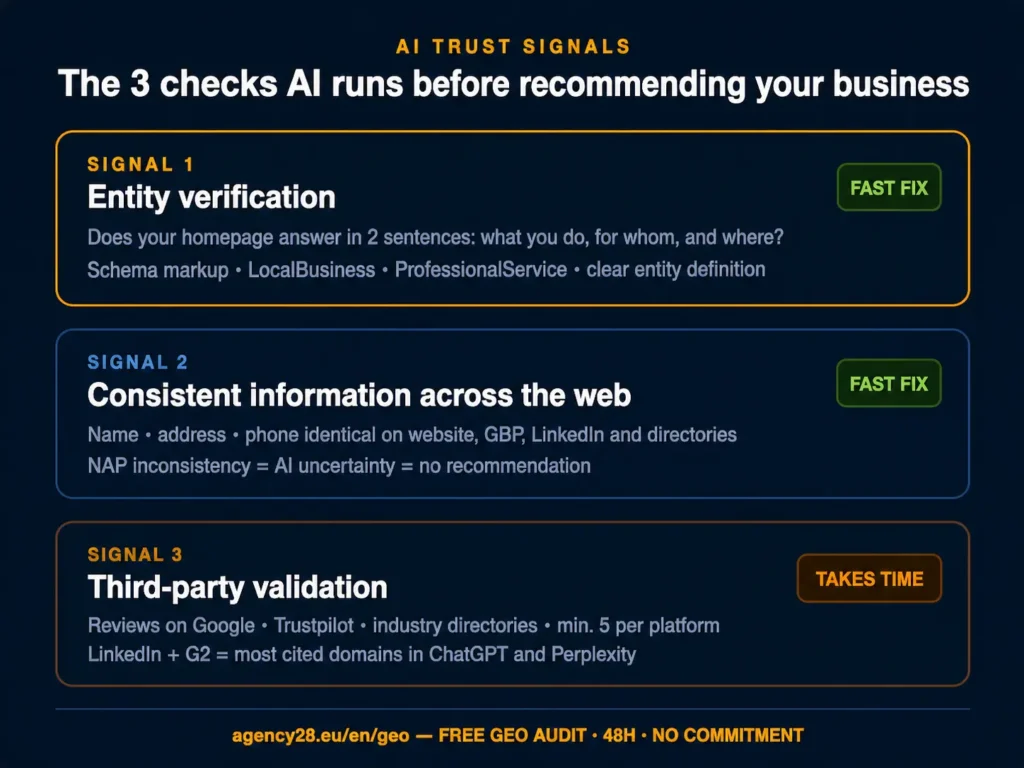
That classification is based on three trust signals. All three need to be in place. Having one of them isn’t enough.
Signal 1 — Entity verification: does AI know you exist?
Before an AI can recommend you, it needs to identify you as an entity — a clearly defined, real business with a name, a location, a function, and a market. That sounds obvious, but it isn’t. Many businesses exist online without AI systems being able to recognise them as a coherent entity.
How does this work in practice? Your homepage needs to answer three questions in the first two sentences: What does this business do? For whom? Where? If those three questions aren’t answered immediately, the AI can’t classify you correctly. To understand how AI runs this process in full, read this: How AI Decides Which Businesses to Recommend.
What entity verification actually means
It’s not about whether your website looks good. It’s about whether AI can clearly extract the following data from your online presence: business name, location, industry, target audience, services, and geographic market. Schema markup of the LocalBusiness or ProfessionalService type helps AI systems read this data in a structured way — without having to guess.
The fastest way to fail this check
Generic homepages. “We provide world-class solutions for your business” tells an AI nothing. It lacks the specificity needed to assign you to a category, a market, and a target audience. The vaguer your self-description, the more uncertain the AI — and the lower the probability of a recommendation.
[wpcode id=”363″]
Signal 2 — Consistent information across the web
AI systems don’t only verify businesses on their own website. They cross-reference information from multiple sources — your website, your Google Business Profile, LinkedIn, industry directories, review platforms. When these sources show different information, uncertainty is created. And uncertain AI doesn’t recommend.
Why inconsistency is fatal for AI visibility
Imagine your business name appears as “Miller & Partners Ltd” on your website, “Miller and Partners” on your Google Business Profile, and “Miller Partners Ltd” in a directory. To a human, it’s obviously the same company. To an AI system cross-referencing structured data, those are potentially three different entities. This is called NAP inconsistency — Name, Address, Phone — and it’s one of the most common reasons businesses remain invisible in AI search.
The platforms that matter most
Not all platforms carry equal weight. The most important for AI verification are: Google Business Profile, LinkedIn Company Page, your own website with Schema markup, and relevant industry directories. Consistency across these four platforms has the highest leverage for your AI visibility.
Signal 3 — Third-party validation
The third signal is external trust. AI systems only trust your own website so far — you can write whatever you want about yourself. What really counts are sources you don’t control: reviews, mentions on third-party platforms, citations in articles, and entries in verified directories.
Reviews and directory citations
Reviews on Google, Trustpilot, or industry-specific platforms serve as external validation. They tell the AI: real people have interacted with this business and found it credible. A minimum of five reviews per platform is the threshold at which this effect becomes measurable. Fewer than that has almost no impact.
Why LinkedIn and G2 dominate AI citations
LinkedIn is the most cited domain for professional queries across ChatGPT, Perplexity, and Google AI Mode. G2 is the most cited software review platform. The reason is straightforward: these platforms have high entity authority with AI systems themselves — when they list or review your business, part of that authority transfers to you. A complete, up-to-date LinkedIn Company Page is no longer a nice-to-have for B2B businesses. It’s a GEO fundamental.
How the 3 signals work together
Entity verification, consistency, and third-party validation aren’t independent factors. They reinforce each other. A business with a clear entity definition, consistent NAP data, and strong external reviews is easy for AI systems to classify, easy to verify, and easy to recommend. That’s the state a GEO audit works towards.
The good news: most of these problems are fixable — and faster than you’d think. The technical and entity issues can usually be resolved within weeks. The external signals take longer because they depend on third parties. But with the right plan, you know exactly what order to tackle them in.
[wpcode id=”363″]
FAQ
What are trust signals for AI search?
Trust signals are the factors AI systems use to assess whether a business is real, credible, and safe to recommend. The three most important are entity verification (can the AI clearly identify what you do and where?), consistency (is your information identical across all platforms?), and third-party validation (do external sources confirm your existence and credibility?).
Why isn’t a good website enough to get recommended by AI?
Because AI systems cross-reference information from multiple sources, not just your website. An excellent website with inconsistent directory listings or no external reviews can still fail the verification check. AI needs convergent signals from multiple independent sources.
How important is Google Business Profile for AI visibility?
Very important. Google Business Profile is one of the primary sources AI systems use to verify a business. It needs to be fully completed, verified, and consistent with the information on your website. An incomplete or inconsistent GBP can actively damage your AI visibility.
How long does it take to improve trust signals?
Entity problems and NAP inconsistencies can often be fixed within two to four weeks. External signals like reviews and citations take longer — typically two to three months for measurable improvement. The order matters: fix technical and entity problems first, then build external signals.
Wenn ich Unternehmen auditiere, ist das häufigste Problem nicht, dass ihre Website schlecht ist. Es ist, dass KI-Systeme ihnen schlicht nicht vertrauen. Und ohne Vertrauen gibt es keine Empfehlung — egal wie gut dein Produkt oder deine Dienstleistung ist.
KI empfiehlt keine Unternehmen, die sie nicht verifizieren kann. Das ist der Kernmechanismus, den die meisten Unternehmen nicht verstehen, wenn sie sich fragen, warum sie in ChatGPT oder Gemini nicht auftauchen. Falls du noch nicht weißt, was GEO ist, fang hier an: Was ist Generative Engine Optimization (GEO)?
Warum KI dir vertrauen muss, bevor sie dich empfiehlt
KI-Systeme sind keine Suchmaschinen. Sie generieren Antworten, die sie direkt an Nutzer weitergeben — ohne dass der Nutzer selbst überprüfen kann, ob die Quelle vertrauenswürdig ist. Das macht KI-Systeme naturgemäß konservativ: Sie empfehlen nur Unternehmen, die sie mit hoher Sicherheit als real und glaubwürdig klassifizieren können.
Diese Klassifizierung basiert auf drei Vertrauenssignalen. Alle drei müssen stimmen. Eines davon zu haben reicht nicht.
Signal 1 — Entitätsverifizierung: Weiß KI, dass du existierst?
Bevor eine KI dich empfehlen kann, muss sie dich als Entität identifizieren — als klar definiertes, reales Unternehmen mit einem Namen, einem Standort, einer Funktion und einem Markt. Das klingt trivial, ist es aber nicht. Viele Unternehmen existieren online, ohne dass KI-Systeme sie als kohärente Entität erkennen können.
Wie funktioniert das in der Praxis? Deine Homepage muss in den ersten zwei Sätzen beantworten: Was macht dieses Unternehmen? Für wen? Wo? Wenn diese drei Fragen nicht sofort beantwortet werden, kann die KI dich nicht korrekt klassifizieren. Um zu verstehen, wie KI diesen Prozess vollständig durchführt, lies das hier: Wie KI entscheidet, welche Unternehmen sie empfiehlt.
Was Entitätsverifizierung wirklich bedeutet
Es geht nicht darum, ob deine Website gut aussieht. Es geht darum, ob KI die folgenden Daten eindeutig aus deiner Online-Präsenz extrahieren kann: Unternehmensname, Standort, Branche, Zielgruppe, Dienstleistungen und geografischer Markt. Schema-Markup vom Typ LocalBusiness oder ProfessionalService hilft KI-Systemen, diese Daten strukturiert zu lesen — ohne raten zu müssen.
Der schnellste Weg, diese Prüfung zu scheitern
Generische Homepages. “Wir bieten erstklassige Lösungen für Ihr Unternehmen” sagt einer KI nichts. Es fehlt die Spezifität, die sie braucht, um dich einer Kategorie, einem Markt und einer Zielgruppe zuzuordnen. Je vager deine Selbstbeschreibung, desto unsicherer die KI — und desto geringer die Wahrscheinlichkeit einer Empfehlung.
[wpcode id=”362″]
Signal 2 — Konsistente Informationen im Web
KI-Systeme verifizieren Unternehmen nicht nur auf deren eigener Website. Sie gleichen Informationen aus mehreren Quellen ab — deiner Website, deinem Google Business Profile, LinkedIn, Branchenverzeichnissen, Bewertungsplattformen. Wenn diese Quellen unterschiedliche Informationen zeigen, entsteht Unsicherheit. Und unsichere KI empfiehlt nicht.
Warum Inkonsistenz für die KI-Sichtbarkeit fatal ist
Stell dir vor, dein Unternehmensname lautet auf deiner Website “Müller & Partner GmbH”, in deinem Google Business Profile “Müller und Partner” und in einem Verzeichnis “Müller Partner GmbH”. Für einen Menschen ist das offensichtlich dasselbe Unternehmen. Für ein KI-System, das Daten strukturiert abgleicht, sind das potenziell drei verschiedene Entitäten. Das nennt sich NAP-Inkonsistenz — Name, Address, Phone — und es ist einer der häufigsten Gründe, warum Unternehmen in KI-Suchen unsichtbar bleiben.
Die Plattformen, die am meisten zählen
Nicht alle Plattformen sind gleich gewichtet. Die wichtigsten für den DACH-Markt sind: Google Business Profile, LinkedIn Company Page, die eigene Website mit Schema-Markup, und relevante Branchenverzeichnisse. Konsistenz auf diesen vier Plattformen hat den größten Hebel für deine KI-Sichtbarkeit.
Signal 3 — Drittanbieter-Validierung
Das dritte Signal ist externes Vertrauen. KI-Systeme vertrauen deiner eigenen Website nur begrenzt — du kannst über dich schreiben, was du willst. Was wirklich zählt, sind Quellen, die du nicht kontrollierst: Bewertungen, Erwähnungen auf Drittanbieter-Plattformen, Zitierungen in Artikeln und Einträge in verifizierten Verzeichnissen.
Bewertungen und Verzeichnis-Zitierungen
Bewertungen auf Google, Trustpilot oder branchenspezifischen Plattformen dienen als externe Validierung. Sie sagen der KI: Echte Menschen haben mit diesem Unternehmen interagiert und es glaubwürdig gefunden. Mindestens fünf Bewertungen pro Plattform sind der Schwellenwert, ab dem dieser Effekt messbar wird. Weniger als das hat kaum Einfluss.
Warum LinkedIn und G2 KI-Zitierungen dominieren
LinkedIn ist die meistzitierte Domain für professionelle Anfragen in ChatGPT, Perplexity und Google AI Mode. G2 ist die meistzitierte Software-Bewertungsplattform. Der Grund ist einfach: Diese Plattformen haben selbst eine hohe Entitätsautorität bei KI-Systemen — wenn sie dein Unternehmen auflisten oder bewerten, überträgt sich ein Teil dieser Autorität auf dich. Eine vollständige, aktuelle LinkedIn Company Page ist für B2B-Unternehmen kein Nice-to-have mehr. Es ist ein GEO-Grundlagenelement.
Wie die 3 Signale zusammenwirken
Entitätsverifizierung, Konsistenz und Drittanbieter-Validierung sind keine unabhängigen Faktoren. Sie verstärken sich gegenseitig. Ein Unternehmen mit klarer Entitätsdefinition, konsistenten NAP-Daten und starken externen Bewertungen ist für KI-Systeme leicht zu klassifizieren, leicht zu verifizieren und leicht zu empfehlen. Das ist der Zustand, den ein GEO-Audit anstrebt.
Das Gute: Die meisten dieser Probleme sind behebbar — und schneller als du denkst. Die technischen und Entitätsprobleme lassen sich in der Regel innerhalb von Wochen lösen. Die externen Signale brauchen etwas länger, weil sie von Dritten abhängen. Aber mit dem richtigen Plan weißt du, in welcher Reihenfolge du vorgehen musst.
[wpcode id=”362″]
FAQ
Was sind Vertrauenssignale für KI-Suchen?
Vertrauenssignale sind die Faktoren, die KI-Systeme verwenden, um zu beurteilen, ob ein Unternehmen real, glaubwürdig und sicher zu empfehlen ist. Die drei wichtigsten sind Entitätsverifizierung (kann die KI klar identifizieren, was du tust und wo?), Konsistenz (sind deine Informationen auf allen Plattformen identisch?) und Drittanbieter-Validierung (bestätigen externe Quellen deine Existenz und Glaubwürdigkeit?).
Warum reicht eine gute Website nicht aus, um von KI empfohlen zu werden?
Weil KI-Systeme Informationen aus mehreren Quellen abgleichen, nicht nur von deiner Website. Eine exzellente Website mit inkonsistenten Verzeichniseinträgen oder ohne externe Bewertungen kann die Verifikationsprüfung trotzdem nicht bestehen. KI braucht konvergente Signale aus mehreren unabhängigen Quellen.
Wie wichtig ist Google Business Profile für die KI-Sichtbarkeit?
Sehr wichtig. Google Business Profile ist eine der primären Quellen, die KI-Systeme nutzen, um ein Unternehmen zu verifizieren. Es muss vollständig ausgefüllt, verifiziert und konsistent mit den Informationen auf der Website sein. Ein unvollständiges oder inkonsistentes GBP kann die KI-Sichtbarkeit aktiv verschlechtern.
Wie lange dauert es, die Vertrauenssignale zu verbessern?
Entitätsprobleme und NAP-Inkonsistenzen lassen sich oft innerhalb von zwei bis vier Wochen beheben. Externe Signale wie Bewertungen und Zitierungen brauchen länger — typischerweise zwei bis drei Monate für messbare Verbesserungen. Die Reihenfolge ist entscheidend: technische und Entitätsprobleme zuerst, externe Signale danach.
Every week someone asks me whether they should focus on SEO or GEO. It’s the wrong question. After years working in search and watching how AI is reshaping discovery, I can tell you that framing it as a choice is the fastest way to end up losing ground on both fronts.
The real question is: do you understand how they differ, and are you optimising for both? If you’re not sure what GEO is yet, start here: What Is Generative Engine Optimization (GEO)?
The core difference in one sentence
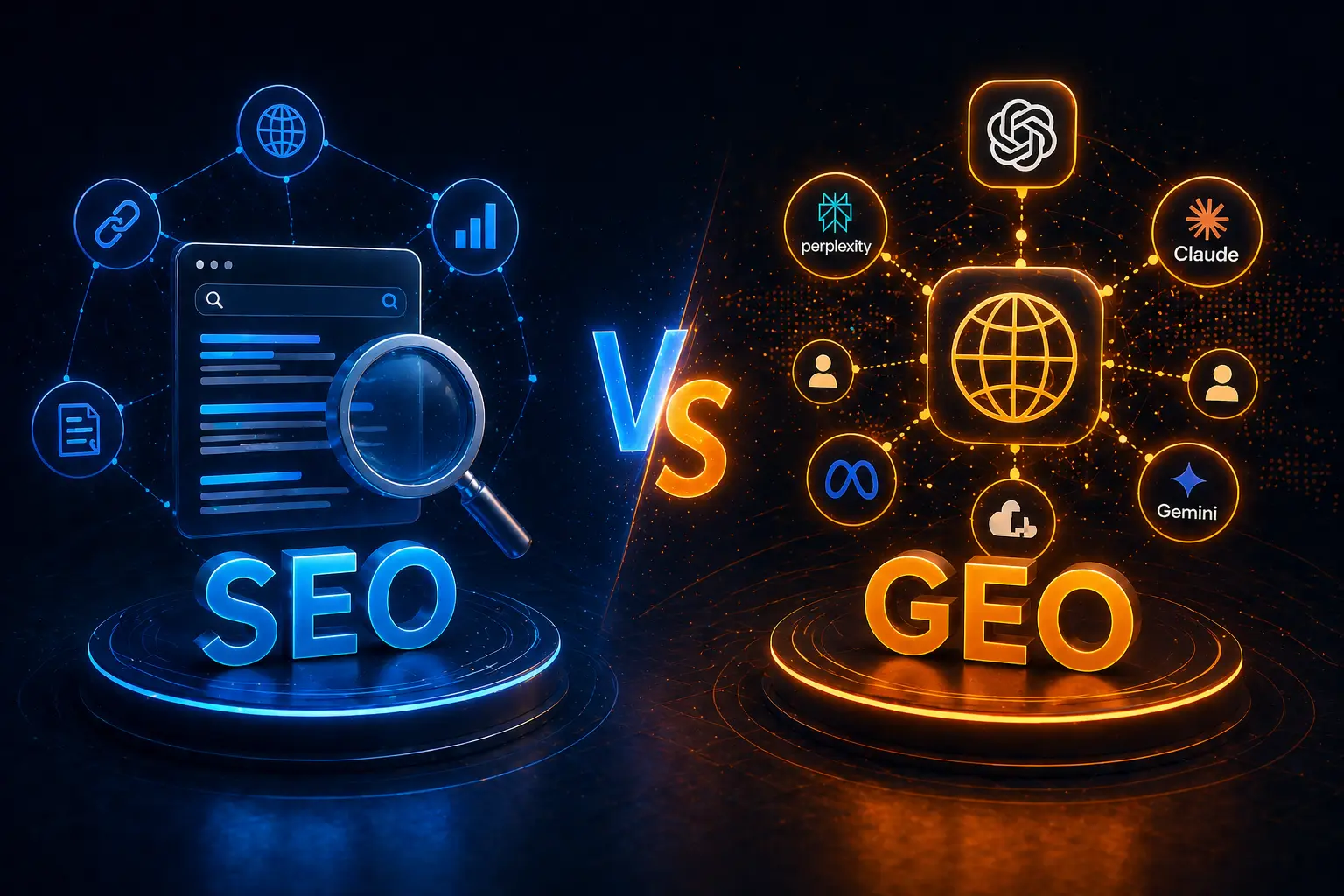
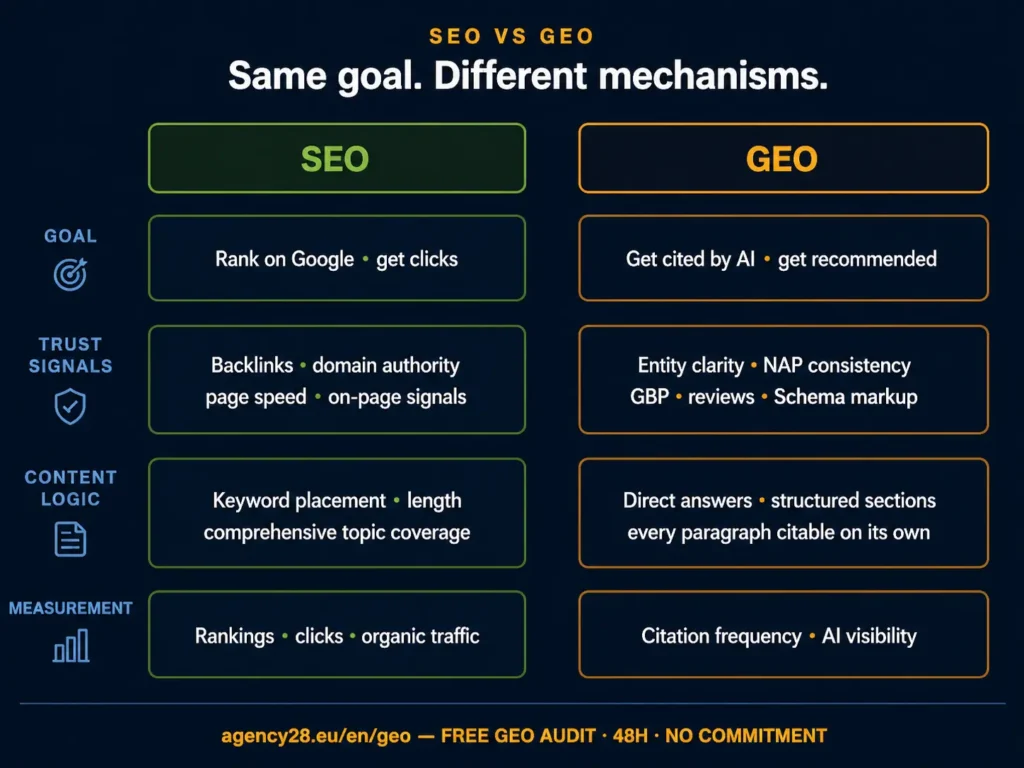
SEO gets you found on Google. GEO gets you recommended by AI. Same goal — visibility — completely different mechanisms.
In SEO, you compete for a position on a results page. The user sees a list of links and chooses which one to click. In GEO, the AI generates a single synthesised answer and cites a handful of sources. Your content is either inside that answer or it isn’t. There is no page two in AI search.
What SEO optimises for vs what GEO optimises for
SEO — rankings and clicks
SEO is about earning a ranked position in Google’s results. You optimise title tags, headings, and body content for specific keywords. You build backlinks to signal authority. You improve page speed and technical structure so Google can crawl and index your content efficiently.
The payoff is traffic. Someone searches, sees your result, clicks through to your site. The entire chain depends on that click happening.
GEO — citations and recommendations
GEO is about being selected as a source inside an AI-generated answer. You optimise for entity clarity, structured content, and consistent information across platforms. You build trust signals — reviews, third-party citations, verified business profiles — so AI systems can confirm you’re a real, credible business.
The payoff is different. Sometimes it’s a direct click from a cited source. Often it’s brand visibility — the user hears your name or sees your information in the AI’s answer before they ever visit your site. AI search visitors convert at 4.4 times the rate of traditional organic visitors, precisely because they arrive having already evaluated options.
[wpcode id=”363″]
Where they overlap — the foundations that serve both
Here’s what most people miss: a strong SEO foundation is also a strong GEO foundation. A fast, crawlable, well-structured site helps both. Clear headings, logical content hierarchy, and schema markup benefit both Google and AI systems. High-quality content that answers questions thoroughly performs well in both channels.
This is why I tell clients not to abandon SEO when they start investing in GEO. The businesses winning in AI search in 2026 almost always have solid SEO fundamentals — it’s the additional GEO-specific layer that pushes them into AI recommendations.
Where they diverge — the 4 key differences
Keyword logic vs topic clarity
SEO rewards keyword placement — the right terms in your title, headings, and body text. GEO doesn’t work that way. AI systems evaluate topics and concepts, not keyword frequency. A page stuffed with “best translation agency Vienna” won’t get cited by ChatGPT. A page that clearly explains what you do, for whom, and why you’re credible — will.
Backlinks vs entity authority
In SEO, backlinks are the primary trust signal. In GEO, the trust signals are different: consistent NAP data across platforms, a verified Google Business Profile, reviews on relevant directories, LinkedIn presence, and Schema markup. A business with 500 backlinks but no GBP and inconsistent directory listings can rank well on Google and be completely invisible to AI.
Content length vs answer directness
SEO often rewards long, comprehensive content that covers a topic from every angle. GEO rewards directness. AI systems extract fragments — they pull the specific sentence or paragraph that answers a question, regardless of what surrounds it. Every section of your content needs to function as a standalone answer. If the key information is buried after three paragraphs of context, the AI skips it.
Traffic measurement vs citation tracking
SEO success is measured in rankings, clicks, and organic traffic. GEO success is measured differently — how often your brand appears in AI-generated answers, which platforms cite you, and what context surrounds the mention. Most businesses have no visibility into this yet, which is exactly why understanding it now is a competitive advantage.
Can you rank #1 on Google and be invisible to AI?
Yes. And it happens more often than you’d think. A page can rank first for a high-volume keyword and still be completely absent from ChatGPT’s answer to the same query. The signals that determine Google rankings and the signals that determine AI citations are related but not identical.
ChatGPT cites webpages ranking in positions 21 or lower nearly 90% of the time. That means a page buried on page two of Google can still be the primary source cited in an AI response — if it has better entity clarity, more direct answers, and stronger trust signals than the pages ranking above it.
This is one of the most important things I’ve seen in auditing sites for GEO. The playing field isn’t what traditional SEO metrics suggest. To understand exactly how AI makes those selection decisions, read this: How AI Decides Which Businesses to Recommend.
The strategy I recommend in 2026
Don’t choose between SEO and GEO. Build both in parallel, starting from your existing SEO foundation. Audit your AI visibility to understand where the gaps are, fix the technical and entity issues first — they’re usually quick wins — then adapt your content structure so it serves both Google and AI simultaneously.
The businesses that act now have a compounding advantage. AI systems build trust in sources over time, the same way Google builds authority. Starting later means catching up against competitors who are already being cited.
If you want to know exactly where your business stands across both channels, our free GEO audit is the fastest way to find out.
[wpcode id=”363″]
FAQ
What is the main difference between SEO and GEO?
SEO optimises for ranked positions in Google’s search results, driving traffic through clicks. GEO optimises for citations inside AI-generated answers from platforms like ChatGPT, Gemini, and Perplexity. SEO success is measured in rankings and traffic. GEO success is measured in how often AI recommends or cites your business.
Does GEO replace SEO?
No. GEO complements SEO — it doesn’t replace it. Google still drives enormous amounts of traffic, and strong SEO fundamentals directly support GEO. The businesses winning in 2026 are running both strategies in parallel, not choosing between them.
Can a page rank well on Google but be invisible to AI?
Yes. Google rankings and AI citations are determined by related but different signals. A page can rank first on Google and never appear in ChatGPT’s answer to the same query. The reverse is also true — pages ranking on page two of Google are cited in AI responses nearly 90% of the time if they have stronger entity clarity and more direct content structure.
Where should I start if I want to optimise for both SEO and GEO?
Start with a GEO audit. It identifies the specific gaps in your AI visibility — technical access issues, entity signal problems, content structure weaknesses — and tells you what to fix in priority order. Most of the fixes also improve your SEO performance, so the investment serves both channels simultaneously.
Jede Woche fragt mich jemand, ob er sich auf SEO oder GEO konzentrieren soll. Das ist die falsche Frage. Nach Jahren im Suchmaschinenbereich und mit Blick darauf, wie KI die digitale Sichtbarkeit neu gestaltet, kann ich dir sagen: Wer es als Entweder-oder betrachtet, verliert auf beiden Fronten.
Die eigentliche Frage ist: Verstehst du, wie sie sich unterscheiden, und optimierst du für beide? Falls du noch nicht weißt, was GEO ist, fang hier an: Was ist Generative Engine Optimization (GEO)?
Der Kernunterschied in einem Satz
SEO sorgt dafür, dass du bei Google gefunden wirst. GEO sorgt dafür, dass KI dich empfiehlt. Dasselbe Ziel — Sichtbarkeit — völlig unterschiedliche Mechanismen.
Bei SEO kämpfst du um eine Position auf einer Ergebnisseite. Der Nutzer sieht eine Liste von Links und wählt, welchen er anklickt. Bei GEO generiert die KI eine einzige synthetisierte Antwort und zitiert eine Handvoll Quellen. Dein Inhalt ist entweder in dieser Antwort — oder nicht. Es gibt keine zweite Seite in der KI-Suche.
Wofür SEO optimiert und wofür GEO optimiert
SEO — Rankings und Klicks
SEO dreht sich darum, eine Rankingposition in Googles Ergebnissen zu erreichen. Du optimierst Title Tags, Überschriften und Inhalte für bestimmte Keywords. Du baust Backlinks auf, um Autorität zu signalisieren. Du verbesserst Ladegeschwindigkeit und technische Struktur, damit Google deine Inhalte effizient crawlen und indexieren kann.
Das Ergebnis ist Traffic. Jemand sucht, sieht dein Ergebnis, klickt auf deine Seite. Die gesamte Kette hängt von diesem Klick ab.
[wpcode id=”362″]
GEO — Zitierungen und Empfehlungen
GEO dreht sich darum, als Quelle in einer KI-generierten Antwort ausgewählt zu werden. Du optimierst für Entitätsklarheit, strukturierte Inhalte und konsistente Informationen auf allen Plattformen. Du baust Vertrauenssignale auf — Bewertungen, Drittanbieter-Zitierungen, verifizierte Unternehmensprofile — damit KI-Systeme bestätigen können, dass du ein echtes, glaubwürdiges Unternehmen bist.
Das Ergebnis ist anders. Manchmal ist es ein direkter Klick aus einer zitierten Quelle. Oft ist es Markenbekanntheit — der Nutzer hört deinen Namen oder sieht deine Informationen in der Antwort der KI, bevor er deine Website besucht. KI-Suchbesucher konvertieren 4,4-mal häufiger als traditionelle organische Besucher, weil sie bereits mit bewerteten Optionen ankommen.
Wo sie sich überschneiden — die Grundlagen, die beiden nützen
Was die meisten übersehen: Eine starke SEO-Grundlage ist auch eine starke GEO-Grundlage. Eine schnelle, crawlbare, gut strukturierte Website hilft beiden. Klare Überschriften, logische Inhaltshierarchie und Schema-Markup nützen sowohl Google als auch KI-Systemen. Hochwertige Inhalte, die Fragen gründlich beantworten, performen in beiden Kanälen gut.
Deshalb sage ich Kunden, SEO nicht aufzugeben, wenn sie in GEO investieren. Die Unternehmen, die 2026 in der KI-Suche gewinnen, haben fast immer solide SEO-Grundlagen — es ist die zusätzliche GEO-spezifische Schicht, die sie in KI-Empfehlungen bringt.
Wo sie sich unterscheiden — die 4 wichtigsten Unterschiede
Keyword-Logik vs. Themenklarheit
SEO belohnt Keyword-Platzierung — die richtigen Begriffe in Titel, Überschriften und Fließtext. GEO funktioniert anders. KI-Systeme bewerten Themen und Konzepte, keine Keyword-Häufigkeit. Eine Seite voller “beste Übersetzungsagentur Wien” wird von ChatGPT nicht zitiert. Eine Seite, die klar erklärt, was du machst, für wen und warum du glaubwürdig bist — schon.
Backlinks vs. Entitätsautorität
Im SEO sind Backlinks das primäre Vertrauenssignal. Im GEO sind die Vertrauenssignale anders: konsistente NAP-Daten auf allen Plattformen, ein verifiziertes Google Business Profile, Bewertungen in relevanten Verzeichnissen, LinkedIn-Präsenz und Schema-Markup. Ein Unternehmen mit 500 Backlinks, aber ohne GBP und mit inkonsistenten Verzeichniseinträgen kann bei Google gut ranken und für KI völlig unsichtbar sein.
Inhaltslänge vs. Antwortdirektheit
SEO belohnt oft lange, umfassende Inhalte, die ein Thema von jeder Seite beleuchten. GEO belohnt Direktheit. KI-Systeme extrahieren Fragmente — sie nehmen den spezifischen Satz oder Absatz, der eine Frage beantwortet, unabhängig davon, was drumherum steht. Jeder Abschnitt deiner Inhalte muss als eigenständige Antwort funktionieren. Wenn die wichtigste Information nach drei Absätzen Kontext vergraben ist, überspringt die KI sie.
Traffic-Messung vs. Zitierungs-Tracking
SEO-Erfolg wird in Rankings, Klicks und organischem Traffic gemessen. GEO-Erfolg wird anders gemessen — wie oft deine Marke in KI-generierten Antworten erscheint, welche Plattformen dich zitieren und in welchem Kontext die Erwähnung steht. Die meisten Unternehmen haben hier noch keine Transparenz — genau deshalb ist dieses Verständnis jetzt ein Wettbewerbsvorteil.
Kann man bei Google auf Platz 1 ranken und für KI unsichtbar sein?
Ja. Und es passiert häufiger als man denkt. Eine Seite kann für ein hochvolumiges Keyword an erster Stelle ranken und trotzdem in ChatGPTs Antwort auf dieselbe Anfrage völlig fehlen. Das Gegenteil gilt genauso — Seiten auf Seite zwei von Google werden in KI-Antworten fast 90% der Zeit zitiert, wenn sie bessere Entitätsklarheit und direktere Inhalte haben.
Das ist eines der wichtigsten Dinge, die ich bei GEO-Audits gesehen habe. Das Spielfeld ist nicht das, was traditionelle SEO-Metriken vermuten lassen. Um zu verstehen, wie KI diese Auswahlentscheidungen trifft, lies das hier: Wie KI entscheidet, welche Unternehmen sie empfiehlt.
Die Strategie, die ich 2026 empfehle
Wähle nicht zwischen SEO und GEO. Baue beides parallel auf, ausgehend von deiner bestehenden SEO-Grundlage. Auditiere deine KI-Sichtbarkeit, um die Lücken zu verstehen, behebe zuerst die technischen und Entitätsprobleme — das sind meist schnelle Gewinne — und passe dann deine Inhaltsstruktur an, damit sie gleichzeitig Google und KI dient.
Die Unternehmen, die jetzt handeln, haben einen Verstärkungseffekt. KI-Systeme bauen Vertrauen in Quellen über Zeit auf, genauso wie Google Autorität aufbaut. Später anzufangen bedeutet, Wettbewerber einzuholen, die bereits zitiert werden.
Wenn du wissen willst, wo dein Unternehmen genau steht — in beiden Kanälen — ist unser kostenloser GEO-Audit der schnellste Weg, das herauszufinden.
[wpcode id=”362″]
FAQ
Was ist der Hauptunterschied zwischen SEO und GEO?
SEO optimiert für Rankingpositionen in Googles Suchergebnissen und generiert Traffic durch Klicks. GEO optimiert für Zitierungen in KI-generierten Antworten von Plattformen wie ChatGPT, Gemini und Perplexity. SEO-Erfolg wird in Rankings und Traffic gemessen. GEO-Erfolg daran, wie oft KI dein Unternehmen empfiehlt oder zitiert.
Ersetzt GEO SEO?
Nein. GEO ergänzt SEO — es ersetzt es nicht. Google generiert nach wie vor enorme Traffic-Mengen, und starke SEO-Grundlagen unterstützen GEO direkt. Die Unternehmen, die 2026 gewinnen, fahren beide Strategien parallel, anstatt zwischen ihnen zu wählen.
Kann eine Seite bei Google gut ranken und für KI unsichtbar sein?
Ja. Google-Rankings und KI-Zitierungen werden durch verwandte, aber unterschiedliche Signale bestimmt. Eine Seite kann bei Google an erster Stelle ranken und nie in ChatGPTs Antwort auf dieselbe Anfrage erscheinen. Umgekehrt werden Seiten auf Seite zwei von Google in KI-Antworten fast 90% der Zeit zitiert, wenn sie stärkere Entitätsklarheit und direktere Inhaltsstruktur haben.
Wo soll ich anfangen, wenn ich für SEO und GEO optimieren will?
Starte mit einem GEO-Audit. Es identifiziert die spezifischen Lücken in deiner KI-Sichtbarkeit — technische Zugangsprobleme, Entitätssignal-Schwächen, Inhaltsstruktur-Mängel — und sagt dir, was du in welcher Priorität beheben musst. Die meisten Korrekturen verbessern auch deine SEO-Performance, sodass die Investition beiden Kanälen gleichzeitig zugute kommt.
Most businesses assume AI recommendations work like Google rankings — publish content, build links, wait for results. That’s not how it works. I’ve audited enough websites to tell you that the businesses showing up consistently in ChatGPT and Gemini aren’t necessarily the biggest or the best-known. They’re the ones that are easiest for AI to verify.
Understanding this changes everything about how you approach your online presence. If you’re not familiar with GEO yet, start here first: What Is Generative Engine Optimization (GEO)?
The two-stage process AI uses to select businesses
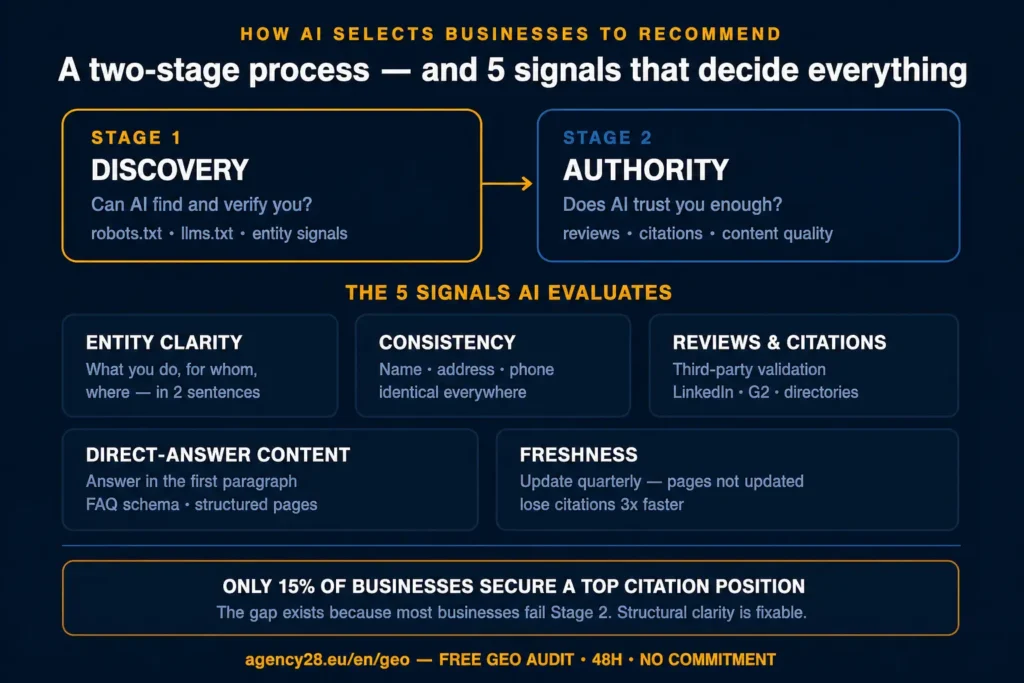
According to Semrush’s AI Visibility Index, AI models use a two-stage process every time they decide which businesses to include in a response. Most businesses only think about one of the two stages — and that’s why they keep getting ignored.
Stage 1 — Discovery: can AI find and verify you?
Before an AI can recommend your business, it needs to confirm you exist. That means crawling your site, finding consistent information about you across the web, and identifying you as a real, verifiable entity.
If your robots.txt blocks AI crawlers, if your business name is spelled differently on your website versus your Google Business Profile versus your directory listings — you fail this stage. The AI moves on to a competitor that’s easier to process.
Stage 2 — Authority: does AI trust you enough to recommend you?
Once the AI can verify you exist, it decides whether you’re worth recommending. This is where trust signals come in — reviews, third-party citations, the quality of your content, and how recently your information has been updated.
Only 15% of businesses secure a top citation position using their own domain. The rest either don’t appear at all or appear through third-party platforms like directories and review sites. That gap exists almost entirely because of Stage 2.
[wpcode id=”363″]
The 5 signals AI evaluates before recommending a business
Entity clarity
AI systems think in entities, not keywords. An entity is a clearly identifiable thing — a business, a person, a location. Your homepage needs to answer in the first two sentences what you do, who you do it for, and where you operate. If that information is buried or vague, the AI can’t classify you correctly and won’t recommend you.
Consistent information across platforms
Your business name, address, and phone number need to be identical across your website, Google Business Profile, LinkedIn, and every directory you appear in. AI systems cross-reference these sources. Inconsistencies create uncertainty — and AI doesn’t recommend businesses it’s uncertain about.
Reviews and third-party citations
LinkedIn is the most cited domain for professional queries across ChatGPT, Perplexity, and Google AI Mode. G2 is the most cited software review platform. Reviews and mentions on third-party platforms act as external validation — they tell the AI that real people have interacted with your business and found it credible.
Content that answers questions directly
AI cites pages that answer specific questions clearly and directly. Not pages that talk about how great your company is. Not long intros before getting to the point. If someone asks “what does a GEO audit cover,” the AI will cite the page that answers that question in the first paragraph — not the one that spends three paragraphs setting context first.
Freshness — how recently your content was updated
Pages not updated quarterly are three times more likely to lose citations in AI search. AI systems weight recency heavily because outdated information reduces the reliability of a recommendation. This doesn’t mean rewriting everything constantly — it means keeping key pages current with accurate service details, updated case studies, and recent data.
Why some businesses keep showing up and others don’t
There’s a compounding effect at play. Once a business appears consistently in AI recommendations, it collects more attention, more reviews, more references — which makes it even easier for AI to classify it as a safe recommendation. The businesses winning now will be harder to displace in six months.
The flip side is also true. Businesses that are hard to verify, have inconsistent information, or produce generic content get systematically excluded. Not because they’re bad businesses — but because the AI can’t confidently recommend them.
This is fundamentally a confidence problem. If a machine can’t easily verify your business identity and expertise, it will recommend a competitor who is structurally clearer. The good news is that structural clarity is fixable — and most competitors haven’t fixed it yet.
The first step is auditing where you actually stand across both stages. Most businesses have no idea how AI currently sees them — whether they’re passing the discovery stage, what trust signals they’re missing, and which quick fixes would have the biggest impact.
That’s exactly what our free GEO audit covers. We look at all five signals across your site and tell you what to fix, in what order, within 48 hours.
[wpcode id=”363″]
FAQ
How does AI decide which businesses to recommend?
AI uses a two-stage process: first it checks whether it can find and verify your business (discovery), then it evaluates whether you’re trustworthy enough to recommend (authority). The key signals are entity clarity, consistent information across platforms, reviews and third-party citations, direct-answer content, and content freshness.
Why does my business not appear in ChatGPT recommendations?
The most common reasons are: AI crawlers are blocked from accessing your site, your business information is inconsistent across platforms, your content doesn’t answer questions directly, or you have no third-party reviews or citations validating your existence. A GEO audit identifies which of these apply to your specific case.
Does having a Google Business Profile help with AI recommendations?
Yes, significantly. Google Business Profile is one of the primary sources AI systems use to verify that a business is real and locate basic information about it. But it needs to be complete, verified, and consistent with the information on your website and other platforms — partial or inconsistent profiles can actually hurt your AI visibility.
How long does it take to start appearing in AI recommendations?
Most businesses see measurable improvement within 30 to 60 days of fixing the discovery-stage issues — technical access and entity clarity. Authority signals like reviews and citations take longer to build. The businesses that act now have a compounding advantage over those that wait.