
When I talk to local business owners, the most common assumption is that GEO is something for big brands with big budgets. The opposite is true. From everything I've seen in audits, local SMBs start with a structural advantage over national and international competitors in GEO — and almost nobody is using it.
The window is open. But it won't stay open forever. If you're not sure what GEO is yet, start here: What Is Generative Engine Optimization (GEO)?
Why local queries are GEO goldmines
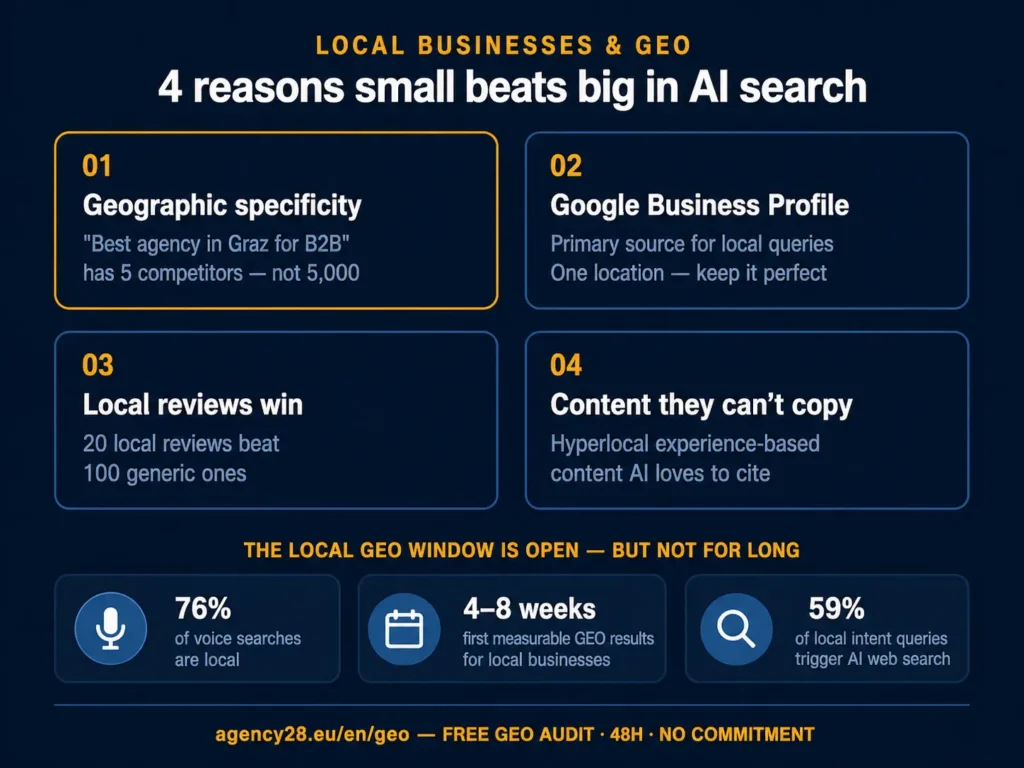
76% of all voice searches are local. And local queries are exactly the type of query that AI systems most often answer with a direct recommendation — not a list of links, but a name, an address, a concrete suggestion.
"Which accountant in Vienna is good for freelancers?" "Best translation agency in Munich for technical documents?" These aren't abstract information requests. These are purchase decisions. And AI is answering them every day — with or without you.
The key difference from general queries: local queries have fewer competitors. "Best marketing agency" has thousands of pages competing for citations. "Best marketing agency in Graz for B2B companies" might have five — and most of them are poorly optimised for GEO.
The local advantage — 4 reasons small beats big in AI search
Geographic specificity is easier to own
Big brands fight for national and international visibility. You fight for Vienna, for the 9th district, for "medical document translators in Austria". That's a much smaller battlefield — and a much easier one to win. AI systems prefer specific, clearly located answers over generic ones. The more precise your geographic positioning, the easier you are to recommend.
Google Business Profile carries more weight locally
For local queries, Google Business Profile is one of the primary sources AI systems consult. A complete, verified GBP with current opening hours, correct address, and detailed service descriptions gives AI exactly the structured data it needs. Large brands often have inconsistent or incomplete GBP entries across multiple locations. You have one — and you can keep it perfect.
Local reviews are more trusted by AI
For local recommendations, AI systems weight reviews from real local customers particularly highly. A trade business with 40 Google reviews from the local area beats a national chain with 200 generic reviews — because the local reviews combine geographic relevance with real customer interaction. That's an advantage you build organically as a local business.
You can create content national competitors can't match
A national competitor can't create a page that authentically talks about "the most common accounting mistakes at Vienna restaurant businesses". You can — because you live it. This kind of hyperlocal, experience-based content is exactly what AI systems cite: specific, credible, non-reproducible.
The local signals AI uses to recommend businesses near you
AI systems combine several local data points before recommending a business for a geographic query. The most important are: Google Business Profile with complete data and active reviews, NAP consistency across all local directories, LocalBusiness Schema markup on the website, and local content that answers specific questions from the target market.
The interplay of these signals determines whether you get recommended for "best [service] in [city]" or not. A detailed explanation of how these trust signals work is here: The 3 Trust Signals AI Uses to Decide Whether to Recommend Your Business.
The one thing most local businesses get wrong
They wait. They assume GEO is something for later — when the technology is more mature, when more customers use AI, when competitors start doing it too. That's the most expensive mistake they can make.
AI systems build trust in sources over time. A business that today has a complete GBP, consistent NAP data, and local content with direct answers will be systematically preferred in six months over a competitor who starts then. The compounding effect works exactly like SEO — whoever starts earlier has a structural advantage that's hard to close.
According to HubSpot data, local businesses can see first measurable GEO results within 4 to 8 weeks — faster than most other business types. The entry point is low. The barrier is knowledge, not budget.
How to claim your local GEO advantage today
The first step is understanding where you currently stand. Which of your local queries is AI already answering? Who's being recommended — you or a competitor? Which of your GEO signals are missing or inconsistent?
Our free GEO audit answers exactly these questions — for your specific business, your market, and your geographic positioning. Within 48 hours you'll know where you stand and what to do next.
FAQ
Do local businesses really have an advantage over big brands in GEO?
Yes, structurally. Local businesses can dominate geographic niches that are too specific for national competitors. AI systems prefer precise, located answers for local queries — and a well-optimised local business regularly beats a large brand with poor local signals.
How important is Google Business Profile for local GEO?
Very important. For local queries, GBP is one of the primary sources AI systems consult. It needs to be fully completed, verified, and consistent with the information on your website. Service descriptions, opening hours, and reviews are particularly relevant.
How many reviews do I need for AI to recommend me locally?
Five reviews per platform is the minimum threshold at which external validation becomes measurable. For local GEO visibility, the quality and geographic relevance of reviews matters more than the raw number. 20 genuine local reviews beat 100 generic ones.
Can a small local business win at GEO without a big budget?
Yes. Most GEO fundamentals — NAP consistency, GBP optimisation, Schema markup, local FAQ pages — require time, not a big budget. Local businesses that implement these foundations correctly typically see first results within 4 to 8 weeks.