
When I audit businesses, the most common problem isn't that their website is bad. It's that AI systems simply don't trust them. And without trust, there's no recommendation — no matter how good your product or service is.
AI doesn't recommend businesses it can't verify. That's the core mechanism most businesses don't understand when they wonder why they don't show up in ChatGPT or Gemini. If you're not sure what GEO is yet, start here: What Is Generative Engine Optimization (GEO)?
Why AI needs to trust you before it recommends you
AI systems aren't search engines. They generate answers that they hand directly to users — without the user being able to verify whether the source is trustworthy. That makes AI systems inherently conservative: they only recommend businesses they can classify as real and credible with high confidence.
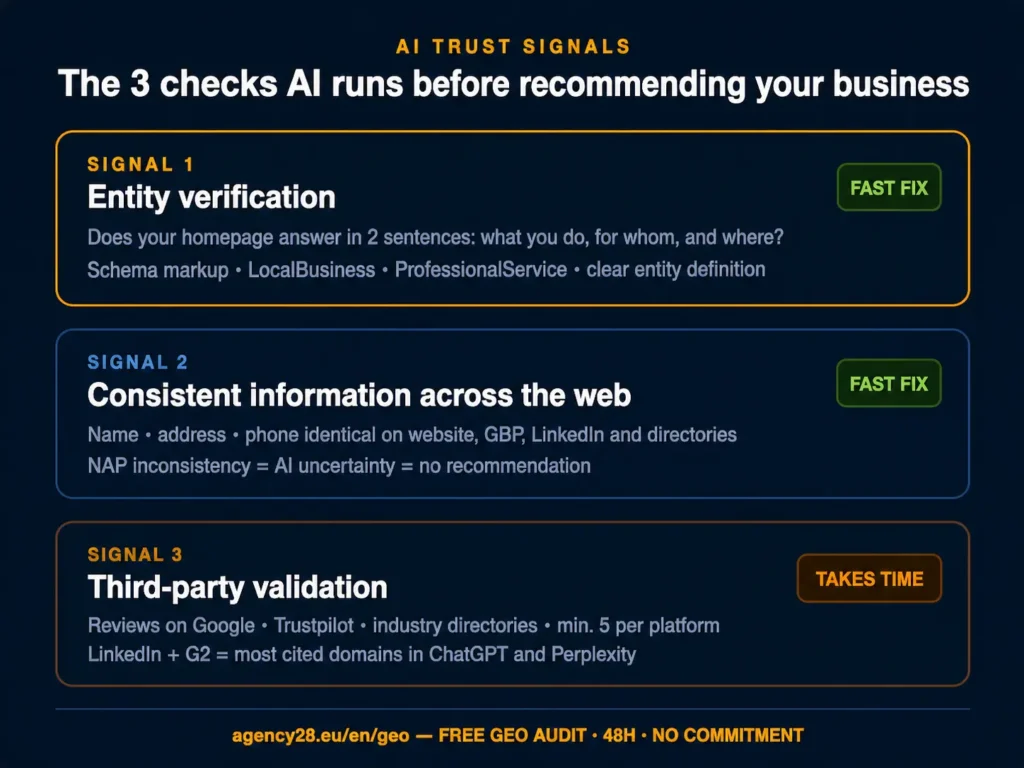
That classification is based on three trust signals. All three need to be in place. Having one of them isn't enough.
Signal 1 — Entity verification: does AI know you exist?
Before an AI can recommend you, it needs to identify you as an entity — a clearly defined, real business with a name, a location, a function, and a market. That sounds obvious, but it isn't. Many businesses exist online without AI systems being able to recognise them as a coherent entity.
How does this work in practice? Your homepage needs to answer three questions in the first two sentences: What does this business do? For whom? Where? If those three questions aren't answered immediately, the AI can't classify you correctly. To understand how AI runs this process in full, read this: How AI Decides Which Businesses to Recommend.
What entity verification actually means
It's not about whether your website looks good. It's about whether AI can clearly extract the following data from your online presence: business name, location, industry, target audience, services, and geographic market. Schema markup of the LocalBusiness or ProfessionalService type helps AI systems read this data in a structured way — without having to guess.
The fastest way to fail this check
Generic homepages. "We provide world-class solutions for your business" tells an AI nothing. It lacks the specificity needed to assign you to a category, a market, and a target audience. The vaguer your self-description, the more uncertain the AI — and the lower the probability of a recommendation.
Signal 2 — Consistent information across the web
AI systems don't only verify businesses on their own website. They cross-reference information from multiple sources — your website, your Google Business Profile, LinkedIn, industry directories, review platforms. When these sources show different information, uncertainty is created. And uncertain AI doesn't recommend.
Why inconsistency is fatal for AI visibility
Imagine your business name appears as "Miller & Partners Ltd" on your website, "Miller and Partners" on your Google Business Profile, and "Miller Partners Ltd" in a directory. To a human, it's obviously the same company. To an AI system cross-referencing structured data, those are potentially three different entities. This is called NAP inconsistency — Name, Address, Phone — and it's one of the most common reasons businesses remain invisible in AI search.
The platforms that matter most
Not all platforms carry equal weight. The most important for AI verification are: Google Business Profile, LinkedIn Company Page, your own website with Schema markup, and relevant industry directories. Consistency across these four platforms has the highest leverage for your AI visibility.
Signal 3 — Third-party validation
The third signal is external trust. AI systems only trust your own website so far — you can write whatever you want about yourself. What really counts are sources you don't control: reviews, mentions on third-party platforms, citations in articles, and entries in verified directories.
Reviews and directory citations
Reviews on Google, Trustpilot, or industry-specific platforms serve as external validation. They tell the AI: real people have interacted with this business and found it credible. A minimum of five reviews per platform is the threshold at which this effect becomes measurable. Fewer than that has almost no impact.
Why LinkedIn and G2 dominate AI citations
LinkedIn is the most cited domain for professional queries across ChatGPT, Perplexity, and Google AI Mode. G2 is the most cited software review platform. The reason is straightforward: these platforms have high entity authority with AI systems themselves — when they list or review your business, part of that authority transfers to you. A complete, up-to-date LinkedIn Company Page is no longer a nice-to-have for B2B businesses. It's a GEO fundamental.
How the 3 signals work together
Entity verification, consistency, and third-party validation aren't independent factors. They reinforce each other. A business with a clear entity definition, consistent NAP data, and strong external reviews is easy for AI systems to classify, easy to verify, and easy to recommend. That's the state a GEO audit works towards.
The good news: most of these problems are fixable — and faster than you'd think. The technical and entity issues can usually be resolved within weeks. The external signals take longer because they depend on third parties. But with the right plan, you know exactly what order to tackle them in.
FAQ
What are trust signals for AI search?
Trust signals are the factors AI systems use to assess whether a business is real, credible, and safe to recommend. The three most important are entity verification (can the AI clearly identify what you do and where?), consistency (is your information identical across all platforms?), and third-party validation (do external sources confirm your existence and credibility?).
Why isn't a good website enough to get recommended by AI?
Because AI systems cross-reference information from multiple sources, not just your website. An excellent website with inconsistent directory listings or no external reviews can still fail the verification check. AI needs convergent signals from multiple independent sources.
How important is Google Business Profile for AI visibility?
Very important. Google Business Profile is one of the primary sources AI systems use to verify a business. It needs to be fully completed, verified, and consistent with the information on your website. An incomplete or inconsistent GBP can actively damage your AI visibility.
How long does it take to improve trust signals?
Entity problems and NAP inconsistencies can often be fixed within two to four weeks. External signals like reviews and citations take longer — typically two to three months for measurable improvement. The order matters: fix technical and entity problems first, then build external signals.