
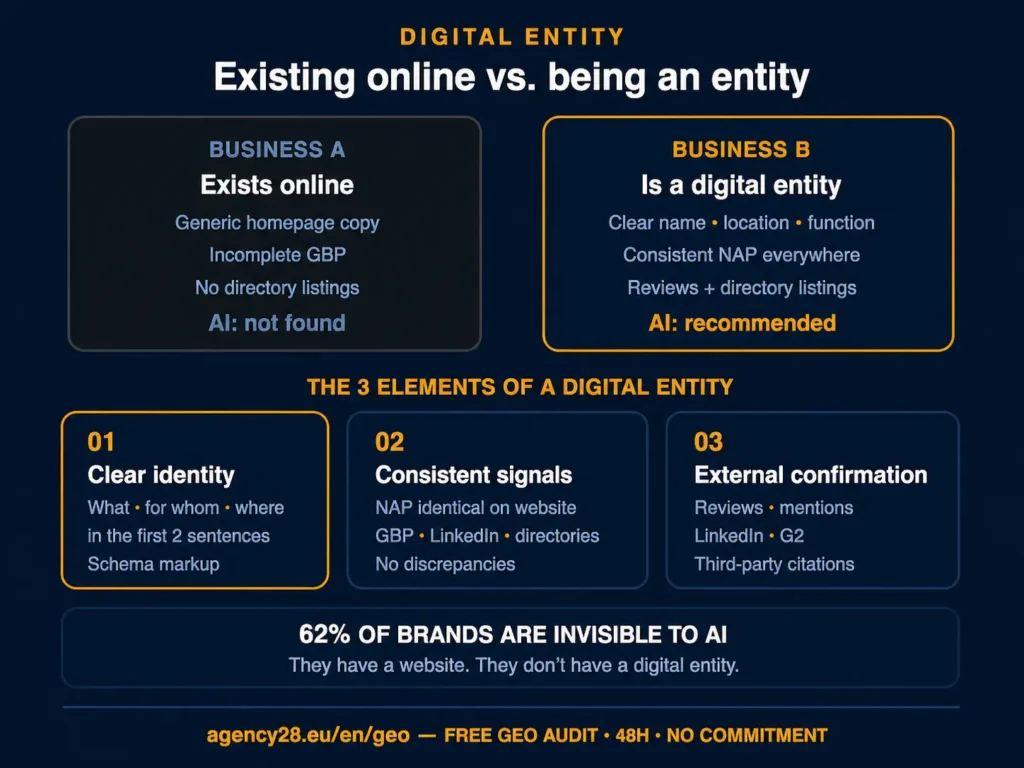
When I explain why a business is invisible in AI search, I almost always come back to the same point: the business exists online — but it isn't a digital entity. That's the difference that explains everything. And it's the concept that most articles about GEO either skip or explain badly.
Let me fix that. If you're not sure what GEO is yet, start here: What Is Generative Engine Optimization (GEO)?
How AI thinks — entities, not keywords
Google and traditional search engines think in keywords. You enter a term, the machine looks for pages containing that term, and ranks them by relevance and authority. AI systems think differently. They think in entities.
An entity, for an AI system, is a clearly identifiable thing in the world — a business, a person, a place, a product. AI builds an internal knowledge graph: which entities exist, what their properties are, what relationships they have with other entities. When someone asks a question, the AI doesn't search for pages with the right keywords — it searches for entities that can answer the question.
If your business isn't registered as an entity in that knowledge graph, you simply don't exist for the AI. Not poorly visible. Not hard to find. Non-existent. To understand how AI uses this process to make recommendations, read this: How AI Decides Which Businesses to Recommend.
What makes a business a digital entity
A digital entity isn't a technical status you apply for. It's a state you reach through consistent, verifiable online presence. Three elements are required.
A clear name, location and function
The AI needs to clearly identify: what is this business called? Where does it operate? What does it do? These three pieces of information need to be available on your homepage in the first two sentences — not somewhere on an about page, not in the footer, not after a long introduction. Immediately, clearly, specifically.
Bad example: "We provide innovative digital solutions for forward-thinking businesses."
Good example: "Agency28 is a GEO and SEO agency in Vienna that helps SMBs in the DACH market become visible in AI search."
The difference isn't aesthetic. It's functional. The second version can be classified by an AI system. The first one can't.
Consistent signals across the web
An entity doesn't only exist on one page — it exists across the web as a whole. That means your business name, address, and phone number need to be identical on your website, Google Business Profile, LinkedIn, industry directories, and review platforms. Every discrepancy weakens the entity signal. The AI starts to question whether it's dealing with one entity or several.
External confirmation from third parties
The strongest entity signal doesn't come from you — it comes from others. When independent sources mention, link to, or review your business, they confirm to AI systems: this entity is real and relevant. That can be reviews, mentions in articles, directory listings, or citations on platforms like LinkedIn or G2. I explain how these external signals work in detail here: The 3 Trust Signals AI Uses to Decide Whether to Recommend Your Business.
Why most businesses don't qualify as entities yet
94% of brands invest in traditional SEO. But 62% are invisible to generative AI models — when asked directly about services in their category, they're not cited in 81% of cases. The reason is almost always the same: they have a website, but not a coherent digital entity.
This happens for three reasons. First: the homepage describes the business too vaguely to be classified. Second: the information is inconsistent across platforms. Third: there are no or too few external sources confirming the business exists.
None of these problems are technically complex. All three are fixable — and faster than most people think.
The difference between existing online and being an entity
Imagine two businesses, both with a website, both with a Google Business Profile, both operating in the same market.
Business A has a homepage with generic marketing copy, a GBP with missing service details, and doesn't appear in any relevant directory. It exists online.
Business B has a homepage that explains in two sentences what it does, for whom, and where. Its GBP is fully completed and consistent with the website. It has reviews on three relevant platforms and is listed in the main industry directories. It is a digital entity.
When someone asks ChatGPT "which translation agency in Vienna is good for medical documents?", Business B appears. Business A doesn't — even though it might offer the better service.
How to build your digital entity step by step
Building a digital entity follows a clear sequence. First the foundation: rewrite the homepage text so that name, location, and function are immediately recognisable. Implement Schema markup of the LocalBusiness or ProfessionalService type. Then consistency: align NAP data across all platforms — website, GBP, LinkedIn, directories. Then external validation: actively collect reviews, list in relevant directories, build LinkedIn presence.
Most businesses can complete the first two steps within two to four weeks. External validation takes longer — but the effect is cumulative and grows over time.
If you want to know where you currently stand and which of these elements you're missing, a GEO audit is the fastest way to find out.
FAQ
What is a digital entity?
A digital entity is a clearly identifiable thing on the web — in this context, a business that AI systems can unambiguously classify. That requires a clear name, location, and function on your own website, consistent information across all relevant platforms, and external confirmation through reviews, directory listings, and third-party mentions.
What's the difference between having a website and being a digital entity?
Having a website means being present online. Being a digital entity means AI systems can clearly identify, classify, and categorise your business as trustworthy. That requires more than a website — it requires consistent, verifiable signals from multiple independent sources.
Do I need a Wikipedia entry to be a digital entity?
No. Wikipedia is a strong entity signal but not a necessary one. For most SMBs, a complete Google Business Profile, consistent NAP data, Schema markup, and reviews on relevant platforms is sufficient to be classified as an entity. Wikipedia becomes relevant when you're operating in a very competitive market.
How long does it take to build a digital entity?
The technical and content foundations — homepage text, Schema markup, NAP consistency — can be implemented within two to four weeks. External validation through reviews and third-party mentions typically takes two to three months for measurable results. The overall process is iterative: each improvement gradually strengthens the entity signal.